Ch 30: Electromagnetic Induction
Knight Calc - Physics for Scientists and Engineers 5th Edition
Knight Calc5th EditionPhysics for Scientists and EngineersISBN: 9780137344796Non è quello che usi tu?Cambia libro di testo
Capitolo 30, Problema 6

An equilateral triangle 8.0 cm on a side is in a 5.0 mT uniform magnetic field. The magnetic flux through the triangle is 6.0 μWb. What is the angle between the magnetic field and an axis perpendicular to the plane of the triangle?

Guida verificata passo dopo passo
1
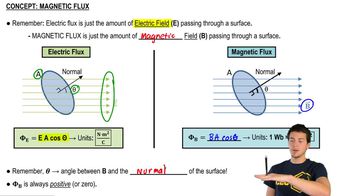
Step 1: Recall the formula for magnetic flux, which is given by Φ = B × A × cos(θ), where Φ is the magnetic flux, B is the magnetic field strength, A is the area of the surface, and θ is the angle between the magnetic field and the normal (perpendicular) to the surface.
Step 2: Calculate the area of the equilateral triangle. The formula for the area of an equilateral triangle is A = (√3 / 4) × s², where s is the length of a side. Substitute s = 8.0 cm (convert to meters: 0.08 m) into the formula to find the area.
Step 3: Rearrange the magnetic flux formula to solve for cos(θ): cos(θ) = Φ / (B × A). Substitute the given values: Φ = 6.0 μWb (convert to webers: 6.0 × 10⁻⁶ Wb), B = 5.0 mT (convert to teslas: 5.0 × 10⁻³ T), and the calculated area A from Step 2.
Step 4: Use the value of cos(θ) obtained in Step 3 to find the angle θ. Take the inverse cosine (arccos) of cos(θ) to determine θ in radians or degrees, depending on the desired unit.
Step 5: Verify the result by checking the units and ensuring the calculated angle is consistent with the physical setup of the problem (e.g., the angle should be between 0° and 90° since the flux is positive).

Risposta video verificata per un problema simile:

Questa soluzione video è stata consigliata dai nostri tutor come utile per risolvere questo problema.

Concetti chiave

Ecco i concetti essenziali che devi comprendere per rispondere correttamente alla domanda.

Magnetic Flux

Magnetic flux is a measure of the quantity of magnetism, taking into account the strength and the extent of a magnetic field. It is defined as the product of the magnetic field strength (B) and the area (A) through which the field lines pass, adjusted for the angle (θ) between the field and the normal to the surface. The formula is given by Φ = B * A * cos(θ), where Φ is the magnetic flux.
Video consigliato:

Uniform Magnetic Field

A uniform magnetic field is one in which the magnetic field strength is constant in both magnitude and direction throughout a given region. This means that any magnetic field lines are parallel and evenly spaced, indicating that the force experienced by a charged particle moving through the field will be consistent. In this problem, the uniform magnetic field is specified as 5.0 mT.
Video consigliato:
Percorso guidato
05:30
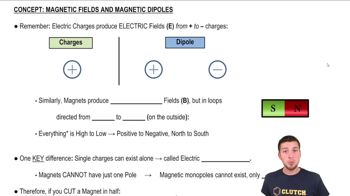
Magnetic Fields and Magnetic Dipoles

Angle Between Magnetic Field and Normal

The angle between the magnetic field and the normal to a surface is crucial for calculating magnetic flux. The normal is an imaginary line perpendicular to the surface, and the angle θ affects how much of the magnetic field passes through the area. In the context of the problem, determining this angle is essential to relate the given magnetic flux to the magnetic field and the area of the triangle.
Video consigliato:
Percorso guidato
05:30
Magnetic Fields and Magnetic Dipoles