Ch 30: Electromagnetic Induction
Knight Calc - Physics for Scientists and Engineers 5th Edition
Knight Calc5th EditionPhysics for Scientists and EngineersISBN: 9780137344796Non è quello che usi tu?Cambia libro di testo
Capitolo 30, Problema 17a

CALC A 5.0-cm-diameter coil has 20 turns and a resistance of 0.50 Ω. A magnetic field perpendicular to the coil is B = 0.020t + 0.010t2, where B is in tesla and t is in seconds. Find an expression for the induced current I(t) as a function of time.

Guida verificata passo dopo passo
1
Step 1: Calculate the area of the coil. The coil is circular, so its area can be calculated using the formula for the area of a circle: A = πr². The diameter of the coil is given as 5.0 cm, so the radius r = diameter / 2 = 5.0 cm / 2 = 2.5 cm = 0.025 m. Substitute this value into the formula to find the area.
Step 2: Determine the magnetic flux Φ(t) through the coil. Magnetic flux is given by Φ(t) = B(t) × A, where B(t) is the magnetic field as a function of time and A is the area of the coil. Substitute the expression for B(t) = 0.020t + 0.010t² and the area calculated in Step 1 into this formula.
Step 3: Calculate the rate of change of magnetic flux dΦ/dt. To find the induced electromotive force (emf), we need the time derivative of the magnetic flux. Differentiate Φ(t) with respect to time t using standard differentiation rules.
Step 4: Use Faraday's law of induction to find the induced emf. Faraday's law states that the induced emf ε = -dΦ/dt. Substitute the result from Step 3 into this formula to find ε(t).
Step 5: Calculate the induced current I(t). Ohm's law relates the current to the emf and resistance: I(t) = ε(t) / R, where R is the resistance of the coil (given as 0.50 Ω). Substitute the expression for ε(t) from Step 4 and the resistance into this formula to find I(t).

Risposta video verificata per un problema simile:

Questa soluzione video è stata consigliata dai nostri tutor come utile per risolvere questo problema.
Durata del video:
7m

Concetti chiave

Ecco i concetti essenziali che devi comprendere per rispondere correttamente alla domanda.

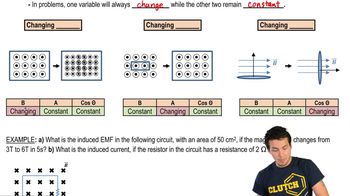
Faraday's Law of Electromagnetic Induction

Faraday's Law states that a change in magnetic flux through a coil induces an electromotive force (EMF) in the coil. The induced EMF is proportional to the rate of change of the magnetic flux, which can be calculated using the formula EMF = -dΦ/dt, where Φ is the magnetic flux. This principle is fundamental for understanding how currents are generated in coils when exposed to varying magnetic fields.
Video consigliato:

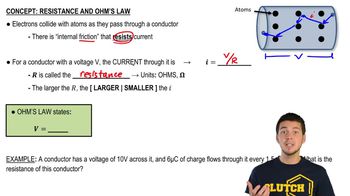
Ohm's Law

Ohm's Law relates the voltage (V), current (I), and resistance (R) in an electrical circuit, expressed as V = IR. In the context of the induced current, the induced EMF from Faraday's Law can be equated to the product of the current and the resistance of the coil. This relationship allows us to calculate the induced current as I(t) = EMF/R, where EMF is derived from the changing magnetic field.
Video consigliato:
Percorso guidato
03:07
Resistance and Ohm's Law

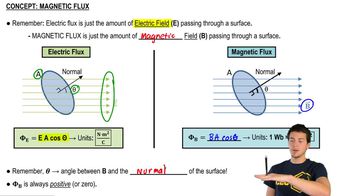
Magnetic Flux

Magnetic flux (Φ) is a measure of the quantity of magnetism, taking into account the strength and the extent of a magnetic field over a given area. It is calculated as Φ = B·A·cos(θ), where B is the magnetic field strength, A is the area of the coil, and θ is the angle between the magnetic field and the normal to the surface of the coil. Understanding magnetic flux is crucial for determining how it changes over time, which directly affects the induced EMF and current.
Video consigliato: