Ch 32: AC Circuits
Knight Calc - Physics for Scientists and Engineers 5th Edition
Knight Calc5th EditionPhysics for Scientists and EngineersISBN: 9780137344796Non è quello che usi tu?Cambia libro di testo
Capitolo 32, Problema 12a

A capacitor has a peak current of 330 μA when the peak voltage at 250 kHz is 2.2 V. What is the capacitance?

Guida verificata passo dopo passo
1
Start by recalling the relationship between the peak current (I₀), the peak voltage (V₀), the angular frequency (ω), and the capacitance (C) for an AC circuit: I₀ = ωC * V₀.
Calculate the angular frequency (ω) using the formula ω = 2πf, where f is the frequency. Here, f = 250 kHz, so substitute this value into the formula.
Rearrange the formula I₀ = ωC * V₀ to solve for the capacitance (C): C = I₀ / (ω * V₀).
Substitute the given values into the formula: I₀ = 330 μA (convert to amperes: 330 × 10⁻⁶ A), V₀ = 2.2 V, and ω (calculated in the previous step).
Simplify the expression to find the capacitance (C). Ensure the units are consistent throughout the calculation.

Risposta video verificata per un problema simile:

Questa soluzione video è stata consigliata dai nostri tutor come utile per risolvere questo problema.

Concetti chiave

Ecco i concetti essenziali che devi comprendere per rispondere correttamente alla domanda.

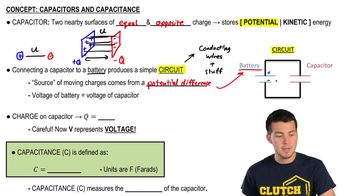
Capacitance

Capacitance is the ability of a capacitor to store electrical charge per unit voltage. It is measured in farads (F) and is defined by the formula C = Q/V, where C is capacitance, Q is the charge stored, and V is the voltage across the capacitor. In AC circuits, capacitance also affects how the capacitor responds to changing voltages.
Video consigliato:
Percorso guidato
08:02
Capacitors & Capacitance (Intro)

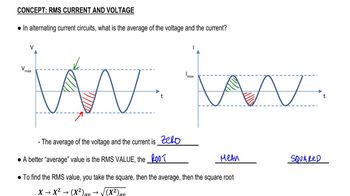
Peak Current and Peak Voltage

Peak current refers to the maximum instantaneous current flowing through a circuit, while peak voltage is the maximum voltage across a component. In the context of capacitors, these values are crucial for determining how the capacitor behaves under alternating current (AC) conditions, particularly at a specific frequency, such as 250 kHz in this case.
Video consigliato:
Percorso guidato
07:14
RMS Current and Voltage

Reactance

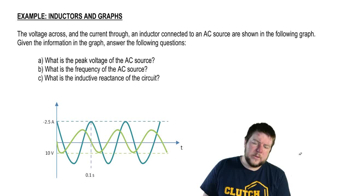
Reactance is the opposition that a capacitor or inductor presents to the flow of alternating current due to its capacitance or inductance. For capacitors, the reactance (Xc) can be calculated using the formula Xc = 1/(2πfC), where f is the frequency and C is the capacitance. This relationship is essential for understanding how capacitors influence current and voltage in AC circuits.
Video consigliato:
Percorso guidato
03:36
Inductors and Graphs