Ch 32: AC Circuits
Knight Calc - Physics for Scientists and Engineers 5th Edition
Knight Calc5th EditionPhysics for Scientists and EngineersISBN: 9780137344796Non è quello che usi tu?Cambia libro di testo
Capitolo 32, Problema 66c

Commercial electricity is generated and transmitted as three-phase electricity. Instead of a single emf ε = ε0 cos ωt, three separate wires carry currents for the emfs ε1 = ε0 cos ωt, ε2 = ε0 cos(ωt+120°), and ε3 = ε0 cos(ωt−120°). This is why the long-distance transmission lines you see in the countryside have three parallel wires, as do many distribution lines within a city. Show that the potential difference between any two of the phases has the rms value 3–√ εrms, where εrms is the familiar single-phase rms voltage. Evaluate this potential difference for εrms = 120 V. Some high-power home appliances, especially electric clothes dryers and hot-water heaters, are designed to operate between two of the phases rather than between one phase and neutral. Heavy-duty industrial motors are designed to operate from all three phases, but full three-phase power is rare in residential or office use.

Guida verificata passo dopo passo
1
Step 1: Understand the problem. We are tasked with finding the root mean square (rms) value of the potential difference between any two phases in a three-phase system. The emfs of the three phases are given as ε1 = ε0 cos(ωt), ε2 = ε0 cos(ωt + 120°), and ε3 = ε0 cos(ωt − 120°). The goal is to show that the rms value of the potential difference between any two phases is √3 εrms, where εrms is the single-phase rms voltage.
Step 2: Write the expression for the potential difference between two phases. For example, the potential difference between phase 1 and phase 2 is ΔV12 = ε1 − ε2. Substituting the given expressions for ε1 and ε2, we have: ΔV12 = ε0 cos(ωt) − ε0 cos(ωt + 120°).
Step 3: Simplify the expression for ΔV12 using trigonometric identities. Use the identity cos(A) − cos(B) = −2 sin((A + B)/2) sin((A − B)/2). Applying this to ΔV12, we get: ΔV12 = −2ε0 sin((ωt + ωt + 120°)/2) sin((ωt − (ωt + 120°))/2). Simplify further to get: ΔV12 = −2ε0 sin(ωt + 60°) sin(−60°).
Step 4: Calculate the rms value of ΔV12. The rms value of a sinusoidal function is given by dividing the amplitude by √2. The amplitude of ΔV12 is 2ε0 sin(60°), where sin(60°) = √3/2. Thus, the amplitude becomes √3ε0. The rms value of ΔV12 is therefore (√3ε0)/√2 = √3 εrms, where εrms = ε0/√2.
Step 5: Evaluate the potential difference for εrms = 120 V. Substitute εrms = 120 V into the expression for the rms potential difference: ΔVrms = √3 εrms. This gives ΔVrms = √3 × 120 V. Perform the numerical calculation to find the final value if needed.

Risposta video verificata per un problema simile:

Questa soluzione video è stata consigliata dai nostri tutor come utile per risolvere questo problema.

Concetti chiave

Ecco i concetti essenziali che devi comprendere per rispondere correttamente alla domanda.

Three-Phase Electricity

Three-phase electricity is a method of alternating current (AC) power generation and transmission that uses three separate conductors, each carrying an alternating current that is offset in time by one-third of a cycle (120 degrees). This configuration allows for a more efficient and stable power supply, as the combined power output is smoother and can deliver more energy than single-phase systems. It is commonly used in industrial applications and for long-distance power transmission.
Video consigliato:
Percorso guidato
08:59
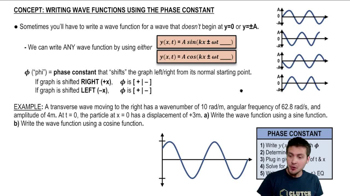
Phase Constant of a Wave Function

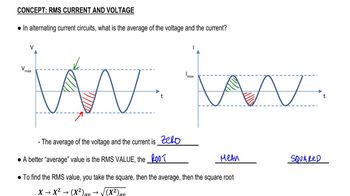
RMS Voltage

RMS (Root Mean Square) voltage is a statistical measure of the magnitude of a varying voltage or current. It represents the equivalent direct current (DC) value that would deliver the same power to a load. For a sinusoidal waveform, the RMS value is calculated as the peak voltage divided by the square root of two, providing a useful way to compare AC voltages to DC voltages in practical applications.
Video consigliato:
Percorso guidato
07:14
RMS Current and Voltage

Potential Difference in Three-Phase Systems

In a three-phase system, the potential difference between any two phases can be derived from the individual phase voltages. The relationship involves the use of vector addition of the phase voltages, leading to a potential difference that is √3 times the RMS voltage of a single phase. This characteristic is crucial for understanding how appliances and motors operate in three-phase systems, as it affects their efficiency and power requirements.
Video consigliato:
Percorso guidato
8:39
Energy Conservation in Three-Mass System
Pratica correlata
Domanda del libro di testo

A motor attached to a 120 V/60 Hz power line draws an 8.0 A current. Its average energy dissipation is 800 W. What is the motor's resistance?

204
views

Domanda del libro di testo

A motor attached to a 120 V/60 Hz power line draws an 8.0 A current. Its average energy dissipation is 800 W. What is the rms resistor voltage?

158
views
Domanda del libro di testo

A generator consists of a 12-cm by 16-cm rectangular loop with 500 turns of wire spinning at 60 Hz in a 25 mT uniform magnetic field. The generator output is connected to a series RC circuit consisting of a 120 Ω resistor and a 35 μF capacitor. What is the average power delivered to the circuit?

1425
views
Domanda del libro di testo

A motor attached to a 120 V/60 Hz power line draws an 8.0 A current. Its average energy dissipation is 800 W. How much series capacitance needs to be added to increase the power factor to 1.0?

1723
views
Domanda del libro di testo

You're the operator of a 15,000 V rms, 60 Hz electrical substation. When you get to work one day, you see that the station is delivering 6.0 MW of power with a power factor of 0.90. What is the rms current leaving the station?

144
views
Domanda del libro di testo

Commercial electricity is generated and transmitted as three-phase electricity. Instead of a single emf, three separate wires carry currents for the emfs ε1 = ε0 cos ωt, ε2 = ε0 cos(ωt +120°), and ε3 = ε0 cos(ωt−120°) over three parallel wires, each of which supplies one-third of the power. This is why the long-distance transmission lines you see in the countryside have three wires. Suppose the transmission lines into a city supply a total of 450 MW of electric power, a realistic value. In fact, transformers are used to step the transmission-line voltage up to 500 kV rms. What is the current in each wire?

1690
views