Ch 32: AC Circuits
Knight Calc - Physics for Scientists and Engineers 5th Edition
Knight Calc5th EditionPhysics for Scientists and EngineersISBN: 9780137344796Non è quello che usi tu?Cambia libro di testo
Capitolo 32, Problema 1a

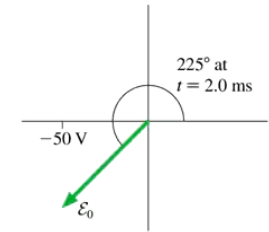
The emf phasor in FIGURE EX32.1 is shown at t = 2.0 ms. What is the angular frequency ω? Assume this is the first rotation.

Guida verificata passo dopo passo
1
Step 1: Understand the problem. The angular frequency ω is related to the rotation of the emf phasor. The phasor completes one full rotation (360°) in a period T, and ω is defined as ω = 2π/T. We need to determine ω using the given information.
Step 2: Analyze the given data. The phasor is at an angle of 225° at t = 2.0 ms. Since this is the first rotation, the phasor started at 0° and rotated to 225° in 2.0 ms. This means the phasor has covered 225° in 2.0 ms.
Step 3: Convert the angle from degrees to radians. Angular frequency is typically expressed in radians per second. Use the conversion factor π radians = 180° to convert 225° to radians: θ = (225 × π) / 180 radians.
Step 4: Calculate the angular frequency ω. Angular frequency is defined as ω = θ / t, where θ is the angle in radians and t is the time taken. Substitute the values of θ (in radians) and t (2.0 ms converted to seconds) into the formula.
Step 5: Simplify the expression for ω. Ensure all units are consistent (time in seconds, angle in radians) and simplify the formula to find ω. This will give the angular frequency in radians per second.

Risposta video verificata per un problema simile:

Questa soluzione video è stata consigliata dai nostri tutor come utile per risolvere questo problema.

Concetti chiave

Ecco i concetti essenziali che devi comprendere per rispondere correttamente alla domanda.

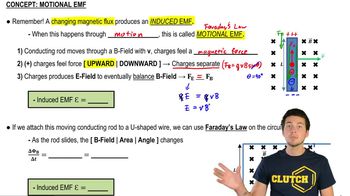
Electromotive Force (emf)

Electromotive force (emf) is a measure of the energy provided by a source of electrical energy per unit charge. It is often represented as a voltage and can be visualized as the potential difference that drives current in a circuit. In the context of phasors, emf can be represented as a rotating vector in the complex plane, indicating both magnitude and phase.
Video consigliato:

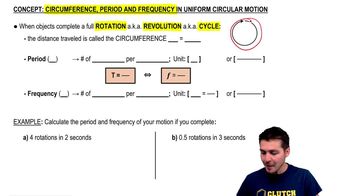
Angular Frequency (ω)

Angular frequency (ω) is a measure of how quickly an object rotates or oscillates, expressed in radians per second. It is related to the frequency (f) of the oscillation by the equation ω = 2πf. In the context of alternating current (AC) circuits, angular frequency is crucial for understanding the behavior of sinusoidal waveforms, including the emf phasor shown in the figure.
Video consigliato:
Percorso guidato
05:08
Circumference, Period, and Frequency in UCM

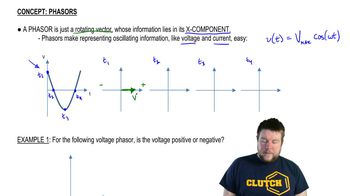
Phasor Representation

Phasor representation is a technique used in electrical engineering to simplify the analysis of sinusoidal functions. A phasor is a complex number that represents the amplitude and phase of a sinusoidal waveform, allowing for easier calculations involving AC circuits. The angle of the phasor indicates the phase shift, while its length corresponds to the amplitude of the waveform.
Video consigliato: