
Ch 33: Wave Optics
Knight Calc - Physics for Scientists and Engineers 5th Edition
Knight Calc5th EditionPhysics for Scientists and EngineersISBN: 9780137344796Non è quello che usi tu?Cambia libro di testo
Capitolo 33, Problema 57

A diffraction grating has slit spacing d. Fringes are viewed on a screen at distance L. Find an expression for the wavelength of light that produces a first-order fringe on the viewing screen at distance L from the center of the screen.

Guida verificata passo dopo passo
1
Start by recalling the diffraction grating equation: nλ = d sin θ, where n is the order of the fringe, λ is the wavelength of light, d is the slit spacing, and θ is the angle of diffraction.
For the first-order fringe, set n = 1. The equation simplifies to λ = d sin θ.
Next, relate the angle θ to the geometry of the setup. The tangent of the angle is given by tan θ = y / L, where y is the distance from the center of the screen to the first-order fringe, and L is the distance from the grating to the screen.
For small angles, sin θ ≈ tan θ. Substitute tan θ into the diffraction equation: λ = d (y / L).
The final expression for the wavelength of light producing the first-order fringe is λ = (d y) / L. This relates the wavelength to the slit spacing, the fringe position, and the screen distance.

Risposta video verificata per un problema simile:

Questa soluzione video è stata consigliata dai nostri tutor come utile per risolvere questo problema.

Concetti chiave

Ecco i concetti essenziali che devi comprendere per rispondere correttamente alla domanda.

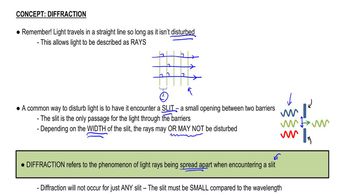
Diffraction Grating

A diffraction grating is an optical component with a periodic structure that splits and diffracts light into several beams. The spacing between the slits, denoted as 'd', determines the angles at which constructive interference occurs, leading to the formation of bright fringes on a screen. The grating's ability to separate light into its component wavelengths is crucial for applications in spectroscopy.
Video consigliato:

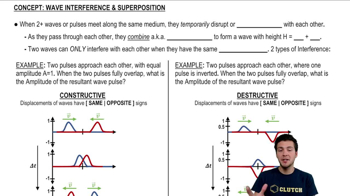
Constructive Interference

Constructive interference occurs when two or more waves combine to produce a wave of greater amplitude. In the context of diffraction, this happens when the path difference between light waves from adjacent slits is an integer multiple of the wavelength. For the first-order fringe, this condition is expressed mathematically, allowing us to derive the wavelength of light based on the observed fringe position.
Video consigliato:
Percorso guidato
03:47
Wave Interference & Superposition

Wavelength and Fringe Position

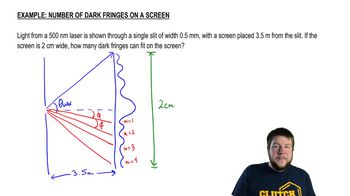
The wavelength of light is the distance between successive peaks of the wave and is a key factor in determining the position of the diffraction fringes. The relationship between the wavelength, slit spacing, and the angle of diffraction is given by the grating equation, which can be rearranged to find the wavelength based on the distance to the screen and the fringe order. Understanding this relationship is essential for solving problems involving diffraction patterns.
Video consigliato:
Percorso guidato
09:05
Number of Dark Fringes on a Screen
Pratica correlata
Domanda del libro di testo

A helium-neon laser (λ = 633 nm) is built with a glass tube of inside diameter 1.0 mm, as shown in FIGURE P33.62. One mirror is partially transmitting to allow the laser beam out. An electrical discharge in the tube causes it to glow like a neon light. From an optical perspective, the laser beam is a light wave that diffracts out through a 1.0-mm-diameter circular opening. Can a laser beam be perfectly parallel, with no spreading? Why or why not?

102
views
Domanda del libro di testo

A radar for tracking aircraft broadcasts a 12 GHz microwave beam from a 2.0-m-diameter circular radar antenna. From a wave perspective, the antenna is a circular aperture through which the microwaves diffract. If the antenna emits 100 kW of power, what is the average microwave intensity at 30 km?

54
views
Domanda del libro di testo

Use your expression from part a to find an expression for the separation Δy on the screen of two fringes that differ in wavelength by Δλ.

1594
views
Domanda del libro di testo

White light (400–700 nm) incident on a 600 lines/mm diffraction grating produces rainbows of diffracted light. What is the width of the first-order rainbow on a screen 2.0 m behind the grating?

89
views
Domanda del libro di testo

A helium-neon laser (λ = 633 nm) is built with a glass tube of inside diameter 1.0 mm, as shown in FIGURE P33.62. One mirror is partially transmitting to allow the laser beam out. An electrical discharge in the tube causes it to glow like a neon light. From an optical perspective, the laser beam is a light wave that diffracts out through a 1.0-mm-diameter circular opening. What is the diameter (in mm) of the laser beam after it travels 3.0 m? Note that the wave model is appropriate because the spreading, at this distance, is significantly larger than the size of the opening.

74
views
Domanda del libro di testo

Helium atoms emit light at several wavelengths. Light from a helium lamp illuminates a diffraction grating and is observed on a screen 50.00 cm behind the grating. The emission at wavelength 501.5 nm creates a first-order bright fringe 21.90 cm from the central maximum. What is the wavelength of the bright fringe that is 31.60 cm from the central maximum?

96
views