Find the focal length of the glass lens in FIGURE EX34.28.
Ch 34: Ray Optics
Knight Calc5th EditionPhysics for Scientists and EngineersISBN: 9780137344796Non è quello che usi tu?Cambia libro di testo
Capitolo 34, Problema 20
A giant ocean tank at an aquarium has acrylic plastic walls 18 cm thick. The index of refraction of acrylic plastic is 1.49. A fish is 220 cm from the inside wall. To a viewer on the outside, how far does the fish appear to be from the outside wall? Hint: The of the first refraction is the object for the second refraction.
Guida verificata passo dopo passo1
Identify the key concept: This problem involves refraction and the apparent position of an object when viewed through a medium with a different index of refraction. We'll use the formula for refraction at a flat surface: \( s' = \frac{s}{n} \), where \( s \) is the object distance, \( s' \) is the apparent distance, and \( n \) is the index of refraction of the medium.
Step 1: Calculate the apparent position of the fish as seen from the inside wall of the acrylic plastic. The fish is located \( s = 220 \; \text{cm} \) from the inside wall, and the index of refraction of acrylic plastic is \( n = 1.49 \). Using the formula \( s' = \frac{s}{n} \), substitute the values to find the apparent position of the fish inside the acrylic plastic.
Step 2: Recognize that the apparent position of the fish inside the acrylic plastic (calculated in Step 1) becomes the object distance for the second refraction, as the light exits the acrylic plastic into air. The index of refraction of air is approximately \( n = 1.00 \).
Step 3: For the second refraction, the object distance is the thickness of the acrylic wall (18 cm) minus the apparent position of the fish inside the acrylic (from Step 1). Use the same refraction formula \( s' = \frac{s}{n} \), where \( s \) is the new object distance and \( n \) is the index of refraction of acrylic plastic, to calculate the apparent position of the fish as seen by the viewer outside the tank.
Step 4: Add the thickness of the acrylic wall (18 cm) to the apparent position of the fish (from Step 3) to determine the total apparent distance of the fish from the outside wall as seen by the viewer.

Risposta video verificata per un problema simile:
Questa soluzione video è stata consigliata dai nostri tutor come utile per risolvere questo problema.
Concetti chiave
Ecco i concetti essenziali che devi comprendere per rispondere correttamente alla domanda.
Refraction
Refraction is the bending of light as it passes from one medium to another with a different index of refraction. This phenomenon occurs because light travels at different speeds in different materials. The degree of bending can be described by Snell's Law, which relates the angles of incidence and refraction to the indices of refraction of the two media.
Video consigliato:
Percorso guidato
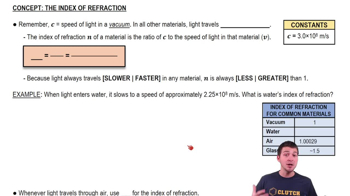
Index of Refraction
Index of Refraction
The index of refraction is a dimensionless number that describes how much light slows down in a medium compared to its speed in a vacuum. It is defined as the ratio of the speed of light in vacuum to the speed of light in the medium. A higher index indicates that light travels slower in that medium, affecting how objects appear when viewed through it.
Video consigliato:
Percorso guidato
Index of Refraction
Optical Path Length
Optical path length is the product of the physical distance light travels in a medium and the index of refraction of that medium. It is a crucial concept in understanding how light behaves as it moves through different materials. In this scenario, calculating the optical path length helps determine how far the fish appears to be from the outside wall after accounting for the refractions at the acrylic walls.
Video consigliato:
Percorso guidato
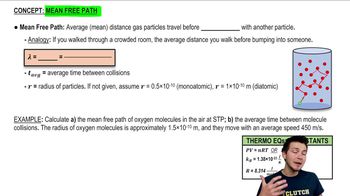
Mean Free Path
Pratica correlata
Domanda del libro di testo
101
views
Domanda del libro di testo
An object is 20 cm in front of a converging lens with a focal length of 10 cm. Use ray tracing to determine the location of the image. Is the upright or inverted?
231
views
Domanda del libro di testo
Find the focal length of the plano-concave polystyrene plastic lens in FIGURE EX34.25.
138
views
Domanda del libro di testo
An underwater diver sees the sun 50° above horizontal. How high is the sun above the horizon to a fisherman in a boat above the diver?
83
views
Domanda del libro di testo
A biologist keeps a specimen of his favorite beetle embedded in a cube of polystyrene plastic. The hapless bug appears to be 2.0 cm within the plastic. What is the beetle's actual distance beneath the surface?
82
views
Domanda del libro di testo
To a fish in an aquarium, the 4.00-mm-thick walls appear to be only 3.50 mm thick. What is the index of refraction of the walls?
79
views