Ch 34: Ray Optics
Knight Calc - Physics for Scientists and Engineers 5th Edition
Knight Calc5th EditionPhysics for Scientists and EngineersISBN: 9780137344796Non è quello che usi tu?Cambia libro di testo
Capitolo 34, Problema 44b

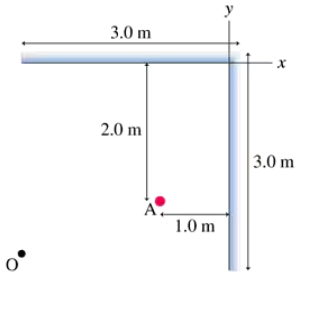
A red ball is placed at point A in FIGURE P34.44. What are the (x, y) coordinates of each image?

Guida verificata passo dopo passo
1
Step 1: Analyze the setup of the problem. The red ball is placed at point A with coordinates (1.0 m, -2.0 m) relative to the origin O. The two mirrors are positioned along the x-axis and y-axis, each extending 3.0 m from the origin.
Step 2: Understand the reflection principle. When an object is reflected in a mirror, its image appears at an equal distance on the opposite side of the mirror. For example, if the object is at (x, y), its reflection in the x-axis will be at (x, -y), and its reflection in the y-axis will be at (-x, y).
Step 3: Calculate the first image formed by the reflection in the x-axis. The coordinates of this image will be (1.0 m, 2.0 m), as the y-coordinate flips sign while the x-coordinate remains unchanged.
Step 4: Calculate the second image formed by the reflection in the y-axis. The coordinates of this image will be (-1.0 m, -2.0 m), as the x-coordinate flips sign while the y-coordinate remains unchanged.
Step 5: Calculate the third image formed by the reflection in both mirrors (x-axis and y-axis). The coordinates of this image will be (-1.0 m, 2.0 m), as both the x-coordinate and y-coordinate flip signs.

Risposta video verificata per un problema simile:

Questa soluzione video è stata consigliata dai nostri tutor come utile per risolvere questo problema.

Concetti chiave

Ecco i concetti essenziali che devi comprendere per rispondere correttamente alla domanda.

Coordinate System

A coordinate system is a method for identifying the position of points in a space using numbers. In two-dimensional space, points are defined by their (x, y) coordinates, where 'x' represents the horizontal position and 'y' represents the vertical position. Understanding this system is crucial for determining the location of objects, such as the red ball at point A in the given problem.
Video consigliato:
Percorso guidato
05:17
Coordinates of Center of Mass of 4 objects

Reflection and Image Formation

In physics, particularly in optics, the concept of reflection involves the bouncing back of light rays when they hit a surface. When an object is placed near a reflective surface, its image can be formed at a position that is symmetrically opposite to the object relative to the surface. This principle is essential for calculating the coordinates of the images of the red ball based on its position and the reflective surfaces in the diagram.
Video consigliato:
Percorso guidato
06:25
Law of Reflection

Distance Measurement

Distance measurement is the process of determining the space between two points, which is fundamental in physics for analyzing positions and movements. In the context of the problem, knowing the distances between point A and the reflective surfaces allows for accurate calculations of the coordinates of the images formed. This involves applying the Pythagorean theorem or simple addition/subtraction of distances in the coordinate system.
Video consigliato:
Percorso guidato
07:49
Proper Frames and Measurements
Pratica correlata
Domanda del libro di testo

An object is 12 cm in front of a concave mirror with a focal length of 20 cm. Use ray tracing to locate the image. Is the image upright or inverted?

239
views

Domanda del libro di testo

A 1.0-cm-tall object is 60 cm in front of a diverging lens that has a −30 cm focal length. Use ray tracing to find the position and height of the image. To do this accurately, use a ruler or paper with a grid. Determine the image distance and image height by making measurements on your diagram.

127
views
Domanda del libro di testo

An advanced computer sends information to its various parts via infrared light pulses traveling through silicon fibers. To acquire data from memory, the central processing unit sends a light-pulse request to the memory unit. The memory unit processes the request, then sends a data pulse back to the central processing unit. The memory unit takes 0.5 ns to process a request. If the information has to be obtained from memory in 2.0 ns, what is the maximum distance the memory unit can be from the central processing unit?

74
views
Domanda del libro di testo

The place you get your hair cut has two nearly parallel mirrors 5.0 m apart. As you sit in the chair, your head is 2.0 m from the nearer mirror. Looking toward this mirror, you first see your face and then, farther away, the back of your head. (The mirrors need to be slightly nonparallel for you to be able to see the back of your head, but you can treat them as parallel in this problem.) How far away does the back of your head appear to be? Neglect the thickness of your head.

97
views
Domanda del libro di testo

A light ray in air is incident on a transparent material whose index of refraction is n. Find an expression for the (non-zero) angle of incidence whose angle of refraction is half the angle of incidence.

72
views
Domanda del libro di testo

The 80-cm-tall, 65-cm-wide tank shown in FIGURE P34.48 is completely filled with water. The tank has marks every 10 cm along one wall, and the 0 cm mark is barely submerged. As you stand beside the opposite wall, your eye is level with the top of the water. Can you see the marks from the top of the tank (the 0 cm mark) going down, or from the bottom of the tank (the 80 cm mark) coming up? Explain.


103
views