Ch 35: Optical Instruments
Knight Calc - Physics for Scientists and Engineers 5th Edition
Knight Calc5th EditionPhysics for Scientists and EngineersISBN: 9780137344796Non è quello che usi tu?Cambia libro di testo
Capitolo 35, Problema 21

A sheet of glass has nred = 1.52 and nviolet = 1.55. A narrow beam of white light is incident on the glass at 30°. What is the angular spread of the light inside the glass?

Guida verificata passo dopo passo
1
Determine the relationship between the angle of refraction and the angle of incidence using Snell's Law: \( n_1 \sin(\theta_1) = n_2 \sin(\theta_2) \), where \( n_1 \) is the refractive index of the medium the light is coming from (air, \( n_1 = 1.00 \)), \( \theta_1 \) is the angle of incidence, \( n_2 \) is the refractive index of the glass, and \( \theta_2 \) is the angle of refraction.
Apply Snell's Law for red light (\( n_{red} = 1.52 \)) to find the angle of refraction for red light: \( \sin(\theta_{red}) = \frac{n_1 \sin(\theta_1)}{n_{red}} \). Substitute \( \theta_1 = 30° \) and solve for \( \theta_{red} \).
Repeat the process for violet light (\( n_{violet} = 1.55 \)) using Snell's Law: \( \sin(\theta_{violet}) = \frac{n_1 \sin(\theta_1)}{n_{violet}} \). Substitute \( \theta_1 = 30° \) and solve for \( \theta_{violet} \).
Calculate the angular spread of the light inside the glass by finding the difference between the angles of refraction for red and violet light: \( \Delta\theta = \theta_{red} - \theta_{violet} \).
Express the angular spread \( \Delta\theta \) in degrees, ensuring that the result reflects the difference in the refractive behavior of red and violet light within the glass.

Risposta video verificata per un problema simile:

Questa soluzione video è stata consigliata dai nostri tutor come utile per risolvere questo problema.

Concetti chiave

Ecco i concetti essenziali che devi comprendere per rispondere correttamente alla domanda.

Refraction

Refraction is the bending of light as it passes from one medium to another with different optical densities. This phenomenon occurs due to a change in the speed of light in different materials, described by Snell's Law, which relates the angles of incidence and refraction to the indices of refraction of the two media.
Video consigliato:
Percorso guidato
03:46
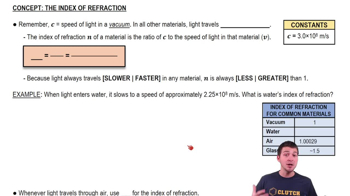
Index of Refraction

Index of Refraction

The index of refraction (n) is a dimensionless number that describes how much light slows down in a medium compared to its speed in a vacuum. In this case, n<sub>red</sub> = 1.52 and n<sub>violet</sub> = 1.55 indicate that violet light travels slower in glass than red light, leading to different angles of refraction for each color.
Video consigliato:
Percorso guidato
03:46
Index of Refraction

Angular Spread

Angular spread refers to the range of angles at which different wavelengths of light are refracted when passing through a medium. In this scenario, the difference in indices of refraction for red and violet light will cause them to bend at different angles, resulting in a spread of colors within the beam as it travels through the glass.
Video consigliato:
Percorso guidato
12:12
Conservation of Angular Momentum
Pratica correlata
Domanda del libro di testo

A 20x telescope has a 12-cm-diameter objective lens. What minimum diameter must the eyepiece lens have to collect all the light rays from an on-axis distant source?

150
views

Domanda del libro di testo

A scientist needs to focus a helium-neon laser beam (⋋ = 633 nm) to a 10-μm-diameter spot 8.0 cm behind a lens. What minimum diameter must the lens have?

117
views
Domanda del libro di testo

A microscope has a 160 mm tube length. What focal-length objective will give total magnification ≈ 500x when used with an eyepiece having a focal length of 5.0 cm?

1737
views
Domanda del libro di testo

A hydrogen discharge lamp emits light with two prominent wavelengths: 656 nm (red) and 486 nm (blue). The light enters a flint-glass prism perpendicular to one face and then refracts through the hypotenuse back into the air. The angle between these two faces is 35°. What is the angle (in degrees) between the red and blue light as it leaves the prism?

2097
views
Domanda del libro di testo

Infrared telescopes, which use special infrared detectors, are able to peer farther into star-forming regions of the galaxy because infrared light is not scattered as strongly as is visible light by the tenuous clouds of hydrogen gas from which new stars are created. For what wavelength of light is the scattering only 1% that of light with a visible wavelength of 500 nm?

119
views
Domanda del libro di testo

A magnifier has a magnification of 5x. How far from the lens should an object be held so that its is seen at the near-point distance of 25 cm? Assume that your eye is immediately behind the lens.

137
views