
Ch 36: Special Relativity
Knight Calc - Physics for Scientists and Engineers 5th Edition
Knight Calc5th EditionPhysics for Scientists and EngineersISBN: 9780137344796Non è quello che usi tu?Cambia libro di testo
Capitolo 36, Problema 31

A laboratory experiment shoots an electron to the left at 0.90c. What is the electron's speed, as a fraction of c, relative to a proton moving to the right at 0.90c?

Guida verificata passo dopo passo
1
Identify that this problem involves relative velocity in the context of special relativity. The classical addition of velocities does not apply here because the speeds involved are close to the speed of light (c). Instead, we use the relativistic velocity addition formula.
Write down the relativistic velocity addition formula: v=u+v1+uvc2, where u is the velocity of the electron relative to the lab, v is the velocity of the proton relative to the lab, and c is the speed of light.
Substitute the given values into the formula. The electron's velocity relative to the lab is -0.90c (negative because it moves to the left), and the proton's velocity relative to the lab is 0.90c (positive because it moves to the right). The formula becomes: v=-0.90c+0.90c1+-0.90c⁢0.90cc2.
Simplify the numerator and denominator of the fraction. The numerator becomes -0.90c+0.90c=0, and the denominator involves simplifying the term 1+-0.90c⁢0.90cc2.
Complete the simplification to find the relative velocity of the electron with respect to the proton. Ensure that the final result is expressed as a fraction of c.

Risposta video verificata per un problema simile:

Questa soluzione video è stata consigliata dai nostri tutor come utile per risolvere questo problema.

Concetti chiave

Ecco i concetti essenziali che devi comprendere per rispondere correttamente alla domanda.

Relativistic Velocity Addition

In special relativity, the velocity of objects moving at significant fractions of the speed of light (c) cannot be simply added together. Instead, the relativistic velocity addition formula must be used, which accounts for the effects of time dilation and length contraction. This formula ensures that the resultant speed never exceeds the speed of light, maintaining the principles of relativity.
Video consigliato:
Percorso guidato
7:27
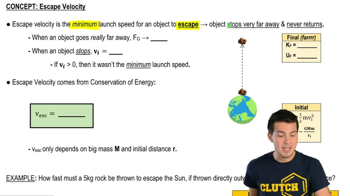
Escape Velocity

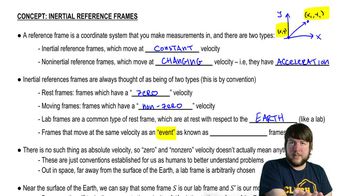
Reference Frames

A reference frame is a perspective from which measurements are made, including the position and speed of objects. In this question, the speeds of the electron and proton are measured relative to different frames of reference. Understanding how to transform between these frames is crucial for accurately calculating relative velocities in relativistic contexts.
Video consigliato:
Percorso guidato
14:10
Inertial Reference Frames

Lorentz Factor

The Lorentz factor is a crucial component in special relativity that quantifies the effects of time dilation and length contraction as an object's speed approaches the speed of light. It is defined as γ = 1 / √(1 - v²/c²), where v is the object's speed. This factor becomes significant at high velocities, influencing how time and space are perceived for fast-moving objects.
Video consigliato:
Percorso guidato
14:16
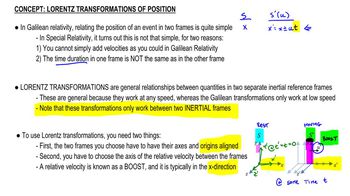
Lorentz Transformations of Position