
Ch 36: Special Relativity
Knight Calc - Physics for Scientists and Engineers 5th Edition
Knight Calc5th EditionPhysics for Scientists and EngineersISBN: 9780137344796Non è quello che usi tu?Cambia libro di testo
Capitolo 36, Problema 53

A rocket traveling at 0.50c sets out for the nearest star, Alpha Centauri, which is 4.3 ly away from earth. It will return to earth immediately after reaching Alpha Centauri. What distance will the rocket travel and how long will the journey last according to (a) stay-at-home earthlings and (b) the rocket crew? (c) Which answers are the correct ones, those in part a or those in part b?

Guida verificata passo dopo passo
1
Step 1: Understand the problem and identify the key concepts. This problem involves special relativity, specifically time dilation and length contraction. The rocket is traveling at a speed of 0.50c (half the speed of light), and the distance to Alpha Centauri is 4.3 light-years (ly) as measured by observers on Earth. The journey involves two perspectives: (a) the stay-at-home earthlings and (b) the rocket crew.
Step 2: Calculate the total distance traveled according to the stay-at-home earthlings. Since the rocket travels to Alpha Centauri and back, the total distance is twice the one-way distance. Use the formula: \( d_{total} = 2 \times d_{one-way} \), where \( d_{one-way} = 4.3 \ \text{ly} \).
Step 3: Calculate the time taken for the journey according to the stay-at-home earthlings. The time for a one-way trip is given by \( t_{one-way} = \frac{d_{one-way}}{v} \), where \( v = 0.50c \). The total time is then \( t_{total} = 2 \times t_{one-way} \).
Step 4: Calculate the distance and time experienced by the rocket crew. Due to length contraction, the distance to Alpha Centauri as measured by the rocket crew is shorter. The contracted distance is given by \( d' = d_{one-way} \sqrt{1 - \frac{v^2}{c^2}} \). The total contracted distance is \( d'_{total} = 2 \times d' \). The time experienced by the rocket crew is given by \( t' = \frac{d'}{v} \).
Step 5: Address part (c) of the problem. The answers in part (a) (stay-at-home earthlings) and part (b) (rocket crew) are both correct, but they are valid in their respective reference frames. This is a fundamental result of special relativity: measurements of time and distance depend on the observer's frame of reference.

Risposta video verificata per un problema simile:

Questa soluzione video è stata consigliata dai nostri tutor come utile per risolvere questo problema.

Concetti chiave

Ecco i concetti essenziali che devi comprendere per rispondere correttamente alla domanda.

Relativity of Simultaneity

The relativity of simultaneity is a key principle in Einstein's theory of relativity, which states that events that are simultaneous in one frame of reference may not be simultaneous in another. This concept is crucial for understanding how different observers, such as those on Earth and in the rocket, perceive time and distance differently due to their relative velocities.
Video consigliato:
Percorso guidato
04:27
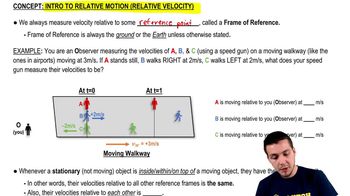
Intro to Relative Motion (Relative Velocity)

Time Dilation

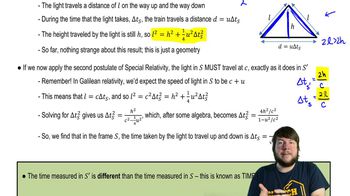
Time dilation is a phenomenon predicted by the theory of relativity, where time passes at different rates for observers in different frames of reference. For the rocket crew traveling at a significant fraction of the speed of light (0.50c), time will pass more slowly compared to the stay-at-home Earthlings, leading to discrepancies in the perceived duration of the journey.
Video consigliato:

Length Contraction

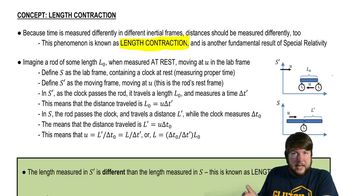
Length contraction is another relativistic effect that states an object in motion will appear shorter in the direction of motion to a stationary observer. In this scenario, while Earthlings measure the distance to Alpha Centauri as 4.3 light-years, the rocket crew will experience a contracted distance due to their high speed, affecting their calculations of the journey's length.
Video consigliato:
Percorso guidato
07:02
Length Contraction
Pratica correlata
Domanda del libro di testo

The half-life of a muon at rest is 1.5 μs. Muons that have been accelerated to a very high speed and are then held in a circular storage ring have a half-life of 7.5 μs. What is the total energy of a muon in the storage ring? The mass of a muon is 207 times the mass of an electron.

115
views
Domanda del libro di testo

Derive a velocity transformation equation for uy and u'y. Assume that the reference frames are in the standard orientation with motion parallel to the x- and x'-axes.

117
views
Domanda del libro di testo

The quantity dE/dv, the rate of increase of energy with speed, is the amount of additional energy a moving object needs per 1 m/s increase in speed. A 25,000 kg rocket is traveling at 0.90c. How much additional energy is needed to increase its speed by 1 m/s?

80
views
Domanda del libro di testo

Two rockets approach each other. Each is traveling at 0.75c in the earth's reference frame. What is the speed, as a fraction of c, of one rocket relative to the other?

1292
views
Domanda del libro di testo

In an attempt to reduce the extraordinarily long travel times for voyaging to distant stars, some people have suggested traveling at close to the speed of light. Suppose you wish to visit the red giant star Betelgeuse, which is 430 ly away, and that you want your 20,000 kg rocket to move so fast that you age only 20 years during the round trip. How fast, as a fraction of c, must the rocket travel relative to earth?

57
views
Domanda del libro di testo

The star Delta goes supernova. One year later and 2.0 ly away, as measured by astronomers in the galaxy, star Epsilon explodes. Let the explosion of Delta be at xD = 0 and tD = 0. The explosions are observed by three spaceships cruising through the galaxy in the direction from Delta to Epsilon at velocities v1 = 0.30c, v2 = 0.50c, and v3 = 0.70c. All three spaceships, each at the origin of its reference frame, happen to pass Delta as it explodes. What are the times of the two explosions as measured by scientists on each of the three spaceships?

99
views