
Ch 37: The Foundations of Modern Physics
Knight Calc - Physics for Scientists and Engineers 5th Edition
Knight Calc5th EditionPhysics for Scientists and EngineersISBN: 9780137344796Non è quello che usi tu?Cambia libro di testo
Capitolo 37, Problema 11c

A 0.80-μm-diameter oil droplet is observed between two parallel electrodes spaced 11 mm apart. The droplet hangs motionless if the upper electrode is 20 V more positive than the lower electrode. The density of the oil is 885 kg/m3. Does the droplet have a surplus or a deficit of electrons? How many?

Guida verificata passo dopo passo
1
Determine the force acting on the droplet due to gravity. The gravitational force is given by \( F_g = m g \), where \( m \) is the mass of the droplet and \( g \) is the acceleration due to gravity. To find \( m \), calculate the volume of the spherical droplet using \( V = \frac{4}{3} \pi r^3 \), where \( r \) is the radius of the droplet (half the diameter). Then, use the density \( \rho \) to find the mass: \( m = \rho V \).
Determine the electric force acting on the droplet. Since the droplet is motionless, the electric force \( F_e \) must balance the gravitational force \( F_g \). The electric force is given by \( F_e = q E \), where \( q \) is the charge on the droplet and \( E \) is the electric field between the electrodes. The electric field can be calculated using \( E = \frac{\Delta V}{d} \), where \( \Delta V \) is the potential difference (20 V) and \( d \) is the separation between the electrodes (11 mm).
Set the magnitudes of the forces equal to each other to solve for the charge \( q \): \( F_g = F_e \), or \( m g = q E \). Rearrange to find \( q \): \( q = \frac{m g}{E} \). Substitute the expressions for \( m \) and \( E \) to calculate \( q \).
Determine whether the droplet has a surplus or deficit of electrons. Since the upper electrode is more positive, the electric field points downward. For the droplet to remain motionless, the electric force must point upward, meaning the droplet must have a negative charge (surplus of electrons).
Calculate the number of excess electrons on the droplet. The charge of a single electron is \( e = 1.6 \times 10^{-19} \; \text{C} \). The number of excess electrons \( n \) is given by \( n = \frac{q}{e} \). Use the value of \( q \) calculated in the previous step to find \( n \).

Risposta video verificata per un problema simile:

Questa soluzione video è stata consigliata dai nostri tutor come utile per risolvere questo problema.
Durata del video:
5m

Concetti chiave

Ecco i concetti essenziali che devi comprendere per rispondere correttamente alla domanda.

Electric Force

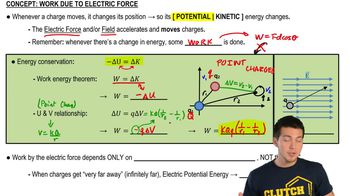
The electric force is the interaction between charged particles, described by Coulomb's law. In this scenario, the electric field created by the voltage difference between the electrodes exerts a force on the charged oil droplet. This force can either balance the gravitational force acting on the droplet or cause it to move, depending on the charge of the droplet.
Video consigliato:
Percorso guidato
14:21
Work due to Electric Force

Gravitational Force

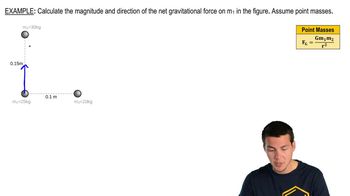
The gravitational force is the attractive force between two masses, calculated using Newton's law of universal gravitation. For the oil droplet, this force is determined by its mass, which can be derived from its volume and density. The droplet's weight must be balanced by the electric force for it to remain motionless between the electrodes.
Video consigliato:
Percorso guidato
05:41
Gravitational Forces in 2D

Charge of an Electron

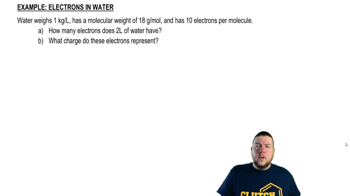
The charge of an electron is a fundamental physical constant, approximately -1.6 x 10^-19 coulombs. To determine whether the droplet has a surplus or deficit of electrons, one must calculate the net charge required to balance the gravitational force with the electric force. The number of excess or deficit electrons can then be found by dividing the total charge by the charge of a single electron.
Video consigliato:
Percorso guidato
04:32
Electrons In Water (Using Density)
Pratica correlata
Domanda del libro di testo

A parallel-plate capacitor with a 1.0 mm plate separation is charged to 75 V. With what kinetic energy, in eV, must a proton be launched from the negative plate if it is just barely able to reach the positive plate?

1420
views
Domanda del libro di testo

Express in eV (or keV or MeV if more appropriate): The kinetic energy of an electron moving with a speed of 5.0 x 10⁶ m/s .

170
views
Domanda del libro di testo

An electron in a cathode-ray beam passes between 2.5-cm-long parallel-plate electrodes that are 5.0 mm apart. A 2.0 mT, 2.5-cm-wide magnetic field is perpendicular to the electric field between the plates. The electron passes through the electrodes without being deflected if the potential difference between the plates is 600 V. What is the electron's speed?

298
views
Domanda del libro di testo

An electron in a cathode-ray beam passes between 2.5-cm-long parallel-plate electrodes that are 5.0 mm apart. A 2.0 mT, 2.5-cm-wide magnetic field is perpendicular to the electric field between the plates. The electron passes through the electrodes without being deflected if the potential difference between the plates is 600 V. If the potential difference between the plates is set to zero, what is the electron's radius of curvature in the magnetic field?

329
views
Domanda del libro di testo

Electrons pass through the parallel electrodes shown in FIGURE EX37.9 with a speed of 5.0×10⁶ m/s. What magnetic field strength and direction will allow the electrons to pass through without being deflected? Assume that the magnetic field is confined to the region between the electrodes.

88
views
Domanda del libro di testo

Determine the speed of a 15 MeV helium atom.

166
views