
Ch 37: The Foundations of Modern Physics
Knight Calc - Physics for Scientists and Engineers 5th Edition
Knight Calc5th EditionPhysics for Scientists and EngineersISBN: 9780137344796Non è quello che usi tu?Cambia libro di testo
Capitolo 37, Problema 27b

What is the velocity, as a fraction of c, of an electron with 2.0 GeV total energy? Hint: This problem uses relativity.

Guida verificata passo dopo passo
1
Start by recalling the total energy equation in special relativity: E = γmc², where γ is the Lorentz factor, m is the rest mass of the electron, and c is the speed of light.
Rearrange the equation to solve for the Lorentz factor γ: γ = E / (mc²). Here, E is the total energy (2.0 GeV), and mc² is the rest energy of the electron (approximately 0.511 MeV). Convert units so they are consistent (e.g., GeV to MeV).
The Lorentz factor is also related to velocity by the equation: γ = 1 / √(1 - v²/c²). Substitute the value of γ obtained in the previous step into this equation.
Rearrange the equation to solve for v/c, the velocity as a fraction of the speed of light: v/c = √(1 - 1/γ²). Plug in the value of γ to compute v/c.
Simplify the expression to find the numerical value of v/c. This will give the velocity of the electron as a fraction of the speed of light.

Risposta video verificata per un problema simile:

Questa soluzione video è stata consigliata dai nostri tutor come utile per risolvere questo problema.

Concetti chiave

Ecco i concetti essenziali che devi comprendere per rispondere correttamente alla domanda.

Relativistic Energy

In the context of special relativity, the total energy of an object is given by the equation E = γmc², where γ (gamma) is the Lorentz factor. This factor accounts for the effects of relativistic speeds, which become significant as an object's velocity approaches the speed of light (c). The total energy includes both rest mass energy and kinetic energy, and understanding this concept is crucial for solving problems involving high-energy particles like electrons.
Video consigliato:
Percorso guidato
04:10
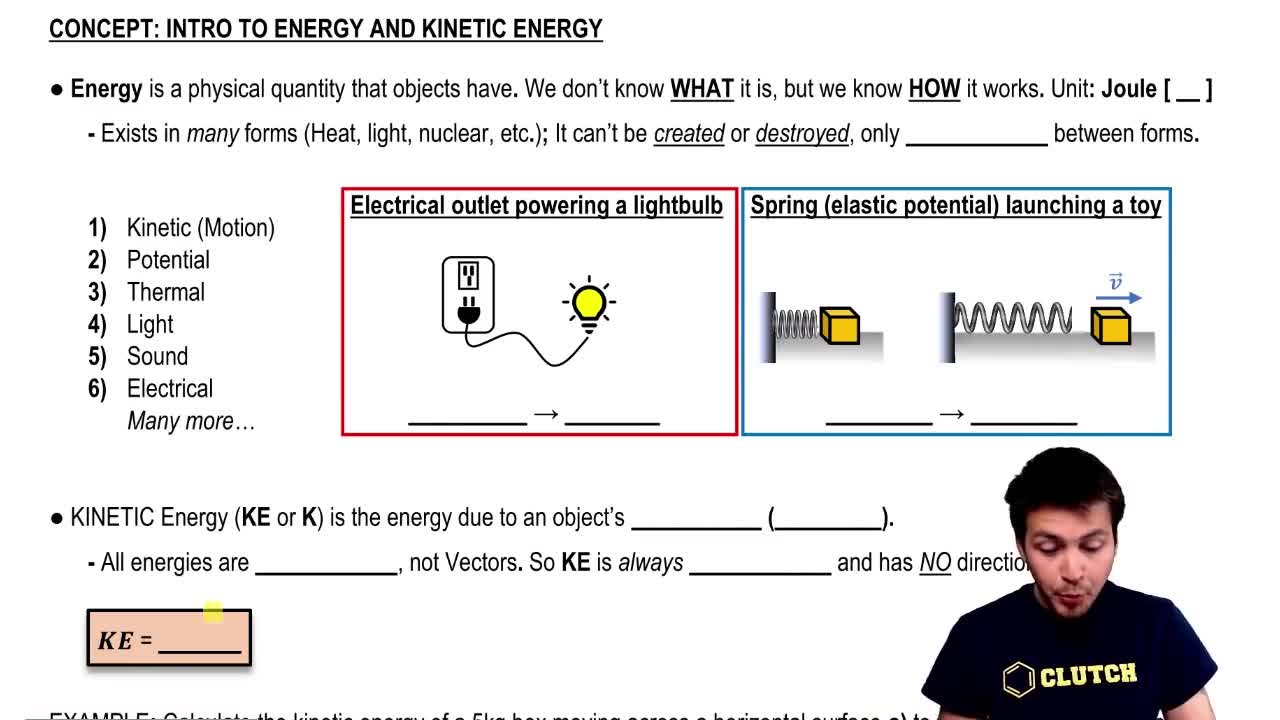
Intro to Energy & Types of Energy

Lorentz Factor

The Lorentz factor, denoted as γ, is defined as γ = 1 / √(1 - v²/c²), where v is the velocity of the object and c is the speed of light. This factor increases as the velocity of the object approaches the speed of light, leading to significant relativistic effects such as time dilation and length contraction. It is essential for calculating the relativistic momentum and energy of particles moving at high speeds.
Video consigliato:
Percorso guidato
14:16
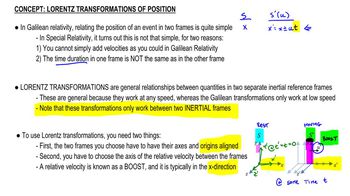
Lorentz Transformations of Position

Velocity as a Fraction of c

In relativistic physics, expressing velocity as a fraction of the speed of light (c) allows for a clearer understanding of how fast an object is moving relative to the ultimate speed limit in the universe. For example, if an electron's velocity is 0.9c, it is traveling at 90% of the speed of light. This concept is vital for analyzing the behavior of particles in high-energy physics, particularly when calculating their relativistic effects.
Video consigliato:
Percorso guidato
04:05
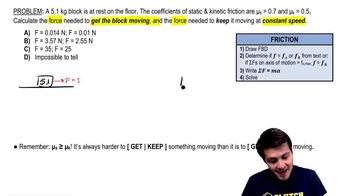
Static & Kinetic Friction
Pratica correlata
Domanda del libro di testo

In one of Thomson’s experiments he placed a thin metal foil in the electron beam and measured its temperature rise. Consider a cathode-ray tube in which electrons are accelerated through a 2000 V potential difference, then strike a 10 mg copper foil. What is the electron-beam current if the foil temperature rises 6.0°C in 10 s? Assume no loss of energy by radiation or other means. The specific heat of copper is 385 J/kg K .

112
views
Domanda del libro di testo

The factor γ appears in many relativistic expressions. A value γ = 1.01 implies that relativity changes the Newtonian values by approximately 1% and that relativistic effects can no longer be ignored. At what kinetic energy, in MeV, is γ = 1.01 for (a) an electron, (b) a proton, and (c) an alpha particle?

84
views
Domanda del libro di testo

Consider the gold isotope 197Au. The gold nucleus has a diameter of 14.0 fm. What is the density of matter in a gold nucleus?

108
views
Domanda del libro di testo

How many electrons, protons, and neutrons are contained in the following atoms or ions: (a) ¹⁰B, (b) ¹³N⁺, and (c) ¹⁷O⁺⁺⁺?

1313
views
Domanda del libro di testo

The fission process n + ²³⁵U → ²³⁶U → ¹⁴⁴Ba + ⁸⁹Kr + 3n converts 0.185 u of mass into the kinetic energy of the fission products. What is the total kinetic energy in MeV?

94
views
Domanda del libro di testo

Identify the isotope that is 11 times as heavy as ¹²C and has 18 times as many protons as ⁶Li . Give your answer in the form ᴬS, where S is the symbol for the element. See Appendix C: Atomic and Nuclear Data.

1087
views