Ch 38: Quantization
Knight Calc - Physics for Scientists and Engineers 5th Edition
Knight Calc5th EditionPhysics for Scientists and EngineersISBN: 9780137344796Non è quello che usi tu?Cambia libro di testo
Capitolo 38, Problema 16

At what speed is an electron’s de Broglie wavelength (a) 1.0 nm, (b) 1.0 μm, and (c) 1.0 mm?

Guida verificata passo dopo passo
1
Step 1: Recall the de Broglie wavelength formula: λ = h / (m * v), where λ is the wavelength, h is Planck's constant (6.626 × 10⁻³⁴ J·s), m is the mass of the electron (9.109 × 10⁻³¹ kg), and v is the speed of the electron. Rearrange the formula to solve for v: v = h / (m * λ).
Step 2: For part (a), substitute λ = 1.0 nm = 1.0 × 10⁻⁹ m into the formula. Use the known values of h and m to calculate the speed v. Ensure all units are consistent (e.g., meters for wavelength, kilograms for mass).
Step 3: For part (b), substitute λ = 1.0 μm = 1.0 × 10⁻⁶ m into the formula. Again, use the same values for h and m to calculate the speed v. Follow the same unit consistency checks.
Step 4: For part (c), substitute λ = 1.0 mm = 1.0 × 10⁻³ m into the formula. Use the same values for h and m to calculate the speed v. Ensure unit consistency as before.
Step 5: After substituting the values for each case, simplify the expression for v in each scenario. The resulting speeds will correspond to the de Broglie wavelengths of 1.0 nm, 1.0 μm, and 1.0 mm, respectively.

Risposta video verificata per un problema simile:

Questa soluzione video è stata consigliata dai nostri tutor come utile per risolvere questo problema.

Concetti chiave

Ecco i concetti essenziali che devi comprendere per rispondere correttamente alla domanda.

de Broglie Wavelength

The de Broglie wavelength is a fundamental concept in quantum mechanics that describes the wave-like behavior of particles. It is given by the formula λ = h/p, where λ is the wavelength, h is Planck's constant, and p is the momentum of the particle. For an electron, this wavelength can be calculated by relating its momentum to its speed and mass.
Video consigliato:
Percorso guidato
05:42
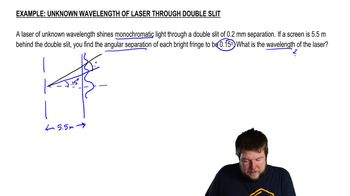
Unknown Wavelength of Laser through Double Slit

Momentum

Momentum is a vector quantity defined as the product of an object's mass and its velocity (p = mv). In the context of quantum mechanics, momentum plays a crucial role in determining the de Broglie wavelength of a particle. For an electron, as its speed increases, its momentum increases, leading to a shorter de Broglie wavelength.
Video consigliato:
Percorso guidato
05:17
Intro to Momentum

Planck's Constant

Planck's constant (h) is a fundamental constant in quantum mechanics, approximately equal to 6.626 x 10^-34 Js. It relates the energy of a photon to its frequency and is essential in the calculation of the de Broglie wavelength. This constant signifies the scale at which quantum effects become significant, influencing the behavior of particles like electrons.
Video consigliato:
Percorso guidato
08:59
Phase Constant of a Wave Function