
Ch 38: Quantization
Knight Calc - Physics for Scientists and Engineers 5th Edition
Knight Calc5th EditionPhysics for Scientists and EngineersISBN: 9780137344796Non è quello che usi tu?Cambia libro di testo
Capitolo 38, Problema 42a

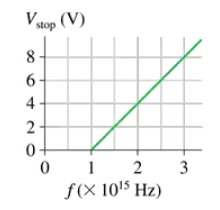
The graph in FIGURE P38.42 was measured in a photoelectric-effect experiment. What is the work function (in eV) of the cathode?

Guida verificata passo dopo passo
1
Step 1: Understand the photoelectric effect equation, which is given by \( eV_{\text{stop}} = hf - \phi \), where \( V_{\text{stop}} \) is the stopping potential, \( h \) is Planck's constant, \( f \) is the frequency of the incident light, and \( \phi \) is the work function of the material.
Step 2: Analyze the graph provided. The graph shows \( V_{\text{stop}} \) (stopping potential) on the y-axis and \( f \) (frequency) on the x-axis. The linear relationship indicates that \( V_{\text{stop}} \) increases with frequency.
Step 3: Identify the threshold frequency \( f_{\text{threshold}} \) from the graph. This is the frequency at which \( V_{\text{stop}} = 0 \). From the graph, \( f_{\text{threshold}} \) appears to be approximately \( 1 \times 10^{15} \, \text{Hz} \).
Step 4: Use the relationship \( \phi = hf_{\text{threshold}} \) to calculate the work function. Here, \( h \) is Planck's constant, \( h = 6.626 \times 10^{-34} \, \text{J·s} \). Convert \( \phi \) to electron volts (eV) using the conversion factor \( 1 \, \text{eV} = 1.602 \times 10^{-19} \, \text{J} \).
Step 5: Substitute \( f_{\text{threshold}} \) and \( h \) into the equation \( \phi = hf_{\text{threshold}} \) and perform the unit conversion to express the work function in eV. This will give the final value of \( \phi \).

Risposta video verificata per un problema simile:

Questa soluzione video è stata consigliata dai nostri tutor come utile per risolvere questo problema.

Concetti chiave

Ecco i concetti essenziali che devi comprendere per rispondere correttamente alla domanda.

Photoelectric Effect

The photoelectric effect is the phenomenon where electrons are emitted from a material, typically a metal, when it is exposed to light of sufficient frequency. This effect demonstrates the particle nature of light, as photons must have enough energy to overcome the work function of the material to release electrons. The relationship between the frequency of incident light and the kinetic energy of emitted electrons is crucial for understanding this effect.
Video consigliato:
Percorso guidato
07:40
The Doppler Effect

Work Function

The work function is the minimum energy required to remove an electron from the surface of a material. It is a critical parameter in the photoelectric effect, as it determines the threshold frequency below which no electrons are emitted, regardless of the intensity of the light. The work function is typically expressed in electronvolts (eV) and can be calculated from the intercept of the graph of stopping potential versus frequency.
Video consigliato:
Percorso guidato
08:30
Intro to Wave Functions

Stopping Potential

Stopping potential is the voltage needed to stop the most energetic photoelectrons emitted from a material in a photoelectric experiment. It is directly related to the kinetic energy of the emitted electrons, which can be calculated using the equation KE = eV_stop, where e is the charge of an electron. The stopping potential is plotted against the frequency of the incident light to determine the work function and analyze the photoelectric effect.
Video consigliato:
Percorso guidato
07:12
Distance to Stop a Point Charge
Pratica correlata
Domanda del libro di testo

INT The electron interference pattern of Figure 38.12 was made by shooting electrons with 50 keV of kinetic energy through two slits spaced 1.0 μm apart. The fringes were recorded on a detector 1.0 m behind the slits. Figure 38.12 is greatly magnified. What was the actual spacing on the detector between adjacent bright fringes?

103
views
Domanda del libro di testo

Potassium and gold cathodes are used in a photoelectric-effect experiment. For each cathode, find: The threshold frequency.

628
views
Domanda del libro di testo

Potassium and gold cathodes are used in a photoelectric-effect experiment. For each cathode, find: The stopping potential if the wavelength is 220 nm.

180
views
Domanda del libro di testo

The cosmic microwave background radiation is light left over from the Big Bang that has been Doppler-shifted to microwave frequencies by the expansion of the universe. It now fills the universe with 450 photons/cm3 at an average frequency of 160 GHz. How much energy from the cosmic microwave background, in MeV, fills a small apartment that has 95 m2 of floor space and 2.5-m-high ceilings?

53
views
Domanda del libro di testo

A 75 kW radio transmitter emits 550 kHz radio waves uniformly in all directions. At what rate do photons strike a 1.5-m-tall, 3.0-mm-diameter antenna that is 15 km away?

132
views
Domanda del libro di testo

BIO The wavelengths of light emitted by a firefly span the visible spectrum but have maximum intensity near 550 nm. A typical flash lasts for 100 ms and has a power output of 1.2 mW. How many photons does a firefly emit in one flash if we assume that all light is emitted at the peak intensity wavelength of 550 nm?

648
views