
Ch 40: One-Dimensional Quantum Mechanics
Knight Calc - Physics for Scientists and Engineers 5th Edition
Knight Calc5th EditionPhysics for Scientists and EngineersISBN: 9780137344796Non è quello che usi tu?Cambia libro di testo
Capitolo 40, Problema 45

A proton’s energy is 1.0 MeV below the top of a 10-fm-wide energy barrier. What is the probability that the proton will tunnel through the barrier?

Guida verificata passo dopo passo
1
Step 1: Understand the problem. The proton is attempting to tunnel through a potential energy barrier. The given data includes the proton's energy (1.0 MeV below the barrier), the width of the barrier (10 fm), and the need to calculate the tunneling probability using quantum mechanics principles.
Step 2: Use the formula for tunneling probability in quantum mechanics: \( T \approx e^{-2 \kappa L} \), where \( \kappa \) is the decay constant, and \( L \) is the width of the barrier. Here, \( L = 10 \; \text{fm} \).
Step 3: Calculate \( \kappa \) using the formula \( \kappa = \sqrt{\frac{2m(U - E)}{\hbar^2}} \), where \( m \) is the mass of the proton, \( U \) is the height of the barrier, \( E \) is the energy of the proton, and \( \hbar \) is the reduced Planck's constant. Substitute the known values: \( U - E = 1.0 \; \text{MeV} \), \( m = 1.67 \times 10^{-27} \; \text{kg} \), and \( \hbar = 1.055 \times 10^{-34} \; \text{J·s} \).
Step 4: Convert the energy difference \( U - E \) from MeV to joules using the conversion factor \( 1 \; \text{MeV} = 1.602 \times 10^{-13} \; \text{J} \). This ensures all units are consistent for the calculation of \( \kappa \).
Step 5: Substitute the calculated \( \kappa \) and \( L \) into the tunneling probability formula \( T \approx e^{-2 \kappa L} \). Simplify the expression to find the approximate tunneling probability.

Risposta video verificata per un problema simile:

Questa soluzione video è stata consigliata dai nostri tutor come utile per risolvere questo problema.

Concetti chiave

Ecco i concetti essenziali che devi comprendere per rispondere correttamente alla domanda.

Quantum Tunneling

Quantum tunneling is a phenomenon in quantum mechanics where a particle has a probability of passing through a potential energy barrier, even if its energy is less than the height of the barrier. This occurs because particles exhibit wave-like properties, allowing them to exist in a superposition of states, which can extend into classically forbidden regions.

Potential Energy Barrier

A potential energy barrier is a region in space where the potential energy of a particle is higher than its total energy. In this context, the barrier is 10 femtometers wide, and the proton's energy being 1.0 MeV below the barrier height indicates that it does not have enough energy to overcome the barrier classically, making tunneling a relevant consideration.
Video consigliato:
Percorso guidato
07:24
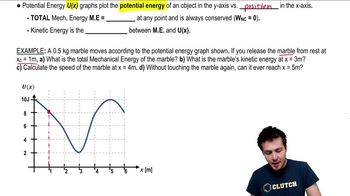
Potential Energy Graphs

Wave Function and Probability

In quantum mechanics, the wave function describes the quantum state of a particle and contains all the information about its position and momentum. The probability of finding a particle in a certain region is given by the square of the wave function's amplitude. For tunneling, the wave function's behavior in the barrier region determines the likelihood of the particle's successful passage through the barrier.
Video consigliato:
Percorso guidato
08:30
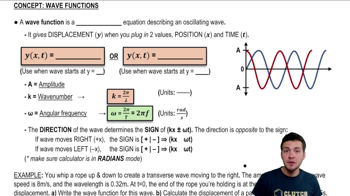
Intro to Wave Functions
Pratica correlata
Domanda del libro di testo

In a nuclear physics experiment, a proton is fired toward a Z = 13 nucleus with the diameter and neutron energy levels shown in Figure 40.17. The nucleus, which was initially in its ground state, subsequently emits a gamma ray with wavelength 1.73×10⁻⁴ nm. What was the minimum initial speed of the proton? Hint: Don't neglect the proton-nucleus collision.

720
views
Domanda del libro di testo

CALC A particle of mass m has the wave function ψ(x) = Ax exp (−x²/a²) when it is in an allowed energy level with E = 0. Find and graph the potential-energy function U(x).

1804
views
Domanda del libro di testo

CALC A particle of mass m has the wave function ψ(x) = Ax exp (−x²/a²) when it is in an allowed energy level with E = 0. At what value or values of x is the particle most likely to be found?

58
views
Domanda del libro di testo

Figure 40.17 showed that a typical nuclear radius is 4.0 fm. As you’ll learn in Chapter 42, a typical energy of a neutron bound inside the nuclear potential well is En = −20 MeV. To find out how “fuzzy” the edge of the nucleus is, what is the neutron’s penetration distance into the classically forbidden region as a fraction of the nuclear radius?

56
views
Domanda del libro di testo

What is the probability that an electron will tunnel through a 0.50 nm air gap from a metal to a STM probe if the work function is 4.0 eV?

69
views
Domanda del libro di testo

The probe passes over an atom that is 0.050 nm “tall.” By what factor does the tunneling current increase?

41
views