
Ch 42: Nuclear Physics
Knight Calc - Physics for Scientists and Engineers 5th Edition
Knight Calc5th EditionPhysics for Scientists and EngineersISBN: 9780137344796Non è quello che usi tu?Cambia libro di testo
Capitolo 42, Problema 43a

You learned in Chapter 41 that the binding energy of the electron in a hydrogen atom is 13.6 eV. By how much does the mass decrease when a hydrogen atom is formed from a proton and an electron? Give your answer both in atomic mass units and as a percentage of the mass of the hydrogen atom.

Guida verificata passo dopo passo
1
Determine the energy equivalent of the binding energy using Einstein's mass-energy equivalence formula: \( E = mc^2 \). Rearrange to find the mass change: \( m = \frac{E}{c^2} \), where \( E = 13.6 \text{ eV} \) and \( c \) is the speed of light.
Convert the binding energy from electron volts (eV) to joules (J) using the conversion factor \( 1 \text{ eV} = 1.602 \times 10^{-19} \text{ J} \).
Substitute the converted energy value into the mass formula \( m = \frac{E}{c^2} \), where \( c = 3.00 \times 10^8 \text{ m/s} \). This will give the mass decrease in kilograms.
Convert the mass decrease from kilograms to atomic mass units (u) using the conversion factor \( 1 \text{ u} = 1.6605 \times 10^{-27} \text{ kg} \).
Calculate the percentage decrease in mass by dividing the mass decrease by the total mass of the hydrogen atom (approximately \( 1.0078 \text{ u} \)) and multiplying by 100%.

Risposta video verificata per un problema simile:

Questa soluzione video è stata consigliata dai nostri tutor come utile per risolvere questo problema.

Concetti chiave

Ecco i concetti essenziali che devi comprendere per rispondere correttamente alla domanda.

Binding Energy

Binding energy is the energy required to separate a system into its individual components. In the context of a hydrogen atom, the binding energy of 13.6 eV represents the energy needed to remove the electron from the proton. This energy is a direct measure of the stability of the atom; higher binding energy indicates a more stable atom.
Video consigliato:
Percorso guidato
04:10
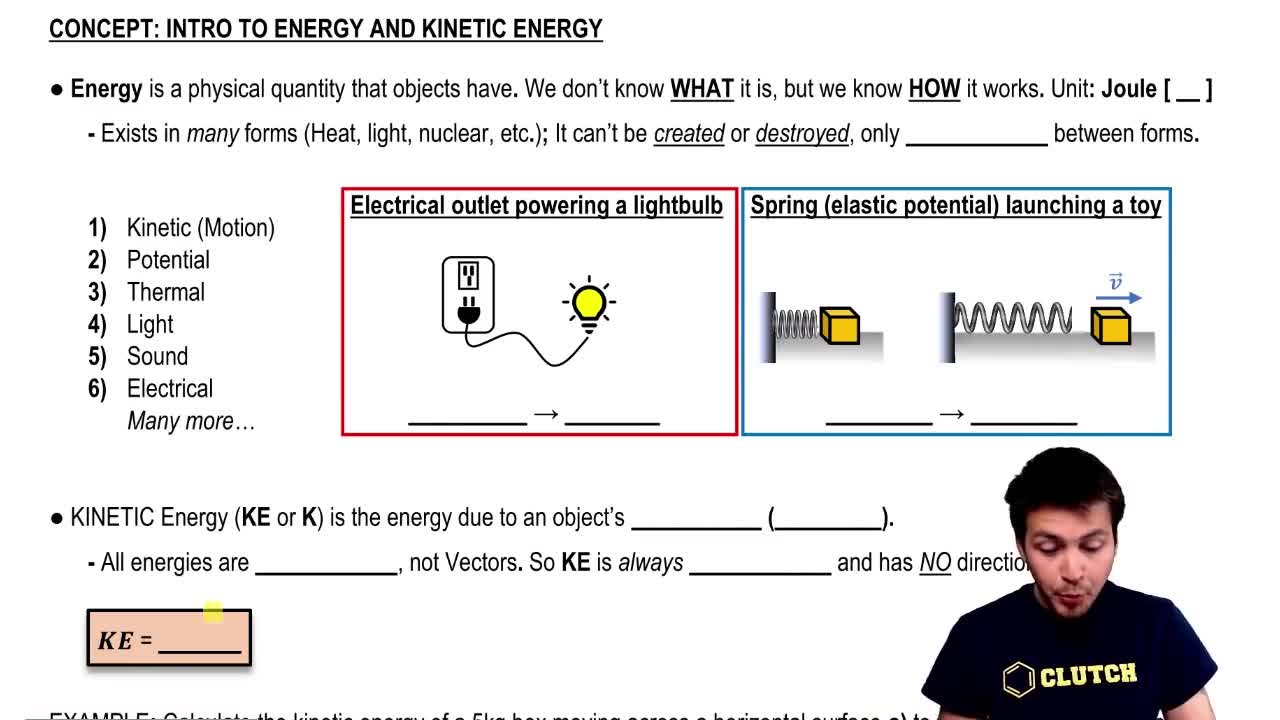
Intro to Energy & Types of Energy

Mass-Energy Equivalence

Mass-energy equivalence, encapsulated in Einstein's equation E=mc², states that mass can be converted into energy and vice versa. When a hydrogen atom is formed from a proton and an electron, the binding energy is released as energy, resulting in a decrease in the total mass of the system. This principle is crucial for calculating the mass defect in atomic systems.
Video consigliato:
Percorso guidato
4:52
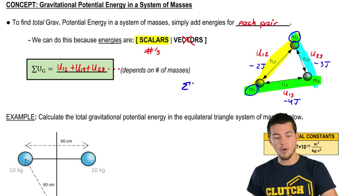
Gravitational Potential Energy for Systems of Masses

Atomic Mass Unit (amu)

An atomic mass unit (amu) is a standard unit of mass that quantifies mass on an atomic or molecular scale. It is defined as one twelfth of the mass of a carbon-12 atom. When calculating the mass decrease during the formation of a hydrogen atom, the result can be expressed in amu to provide a clear and standardized measure of the mass change associated with the binding energy.
Video consigliato:
Percorso guidato
07:46
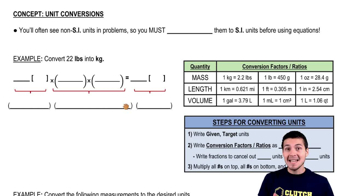
Unit Conversions