
Ch 06: Work & Kinetic Energy
Young & Freedman Calc - University Physics 14th Edition
Young & Freedman Calc14th EditionUniversity PhysicsISBN: 9780321973610Non è quello che usi tu?Cambia libro di testo
Capitolo 6, Problema 16a

A 1.501.50-kg book is sliding along a rough horizontal surface. At point AA it is moving at 3.213.21 m/s, and at point BB it has slowed to 1.251.25 m/s. How much work was done on the book between AA and BB?

Guida verificata passo dopo passo
1
Step 1: Identify the given values from the problem. The mass of the book is \( m = 1.50 \, \text{kg} \), the initial velocity at point A is \( v_A = 3.21 \, \text{m/s} \), and the final velocity at point B is \( v_B = 1.25 \, \text{m/s} \).
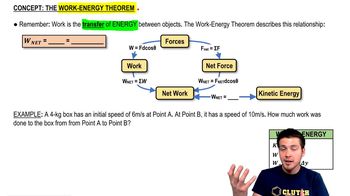
Step 2: Recall the work-energy principle, which states that the work done on an object is equal to the change in its kinetic energy. The formula for kinetic energy is \( KE = \frac{1}{2} m v^2 \).
Step 3: Calculate the initial kinetic energy at point A using \( KE_A = \frac{1}{2} m v_A^2 \). Substitute \( m = 1.50 \, \text{kg} \) and \( v_A = 3.21 \, \text{m/s} \) into the formula.
Step 4: Calculate the final kinetic energy at point B using \( KE_B = \frac{1}{2} m v_B^2 \). Substitute \( m = 1.50 \, \text{kg} \) and \( v_B = 1.25 \, \text{m/s} \) into the formula.
Step 5: Determine the work done on the book by finding the change in kinetic energy: \( W = KE_B - KE_A \). Substitute the values of \( KE_A \) and \( KE_B \) calculated in the previous steps.

Risposta video verificata per un problema simile:

Questa soluzione video è stata consigliata dai nostri tutor come utile per risolvere questo problema.
Durata del video:
3m

Concetti chiave

Ecco i concetti essenziali che devi comprendere per rispondere correttamente alla domanda.

Work-Energy Principle

The Work-Energy Principle states that the work done on an object is equal to the change in its kinetic energy. In this scenario, the work done on the book as it slides from point A to point B can be calculated by finding the difference in kinetic energy at these two points, which is determined by the mass of the book and its velocities.
Video consigliato:
Percorso guidato
04:10
The Work-Energy Theorem

Kinetic Energy

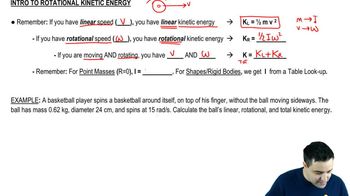
Kinetic energy is the energy an object possesses due to its motion, calculated using the formula KE = 0.5 * m * v^2, where m is the mass and v is the velocity. For the book in this problem, we will compute its kinetic energy at both points A and B to determine how much it has changed as it slows down.
Video consigliato:
Percorso guidato
06:07
Intro to Rotational Kinetic Energy

Friction and Work

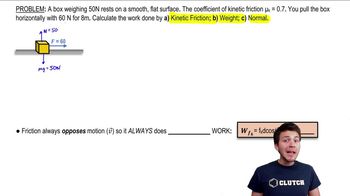
Friction is a force that opposes the motion of an object, and it does work on the object by removing energy from the system. In this case, the rough surface exerts a frictional force on the book, which contributes to the work done on the book as it slows down from point A to point B, affecting its kinetic energy.
Video consigliato:
Percorso guidato
04:29
Work Done By Friction
Pratica correlata
Domanda del libro di testo

A factory worker pushes a 30.030.0-kg crate a distance of 4.54.5 m along a level floor at constant velocity by pushing horizontally on it. The coefficient of kinetic friction between the crate and the floor is 0.250.25. What is the total work done on the crate?

2297
views
Domanda del libro di testo

You throw a 3.003.00-N rock vertically into the air from ground level. You observe that when it is 15.015.0 m above the ground, it is traveling at 25.025.0 m/s upward. Use the work–energy theorem to find its maximum height.

2713
views
Domanda del libro di testo

Two tugboats pull a disabled supertanker. Each tug exerts a constant force of 1.80×1061.80\(\times\)10^6 N, one 14°14° west of north and the other 14°14° east of north, as they pull the tanker 0.750.75 km toward the north. What is the total work they do on the supertanker?

2954
views
Domanda del libro di testo

You throw a 3.003.00-N rock vertically into the air from ground level. You observe that when it is 15.015.0 m above the ground, it is traveling at 25.025.0 m/s upward. Use the work–energy theorem to find the rock's speed just as it left the ground.

7228
views
9
rank
Domanda del libro di testo

Is it reasonable that a 3030-kg child could run fast enough to have 100100 J of kinetic energy?

2410
views
Domanda del libro di testo

A factory worker pushes a 30.030.0-kg crate a distance of 4.54.5 m along a level floor at constant velocity by pushing horizontally on it. The coefficient of kinetic friction between the crate and the floor is 0.250.25. How much work is done on the crate by the normal force? By gravity?

3559
views
1
rank