
Ch 06: Work & Kinetic Energy
Young & Freedman Calc - University Physics 14th Edition
Young & Freedman Calc14th EditionUniversity PhysicsISBN: 9780321973610Non è quello che usi tu?Cambia libro di testo
Capitolo 6, Problema 18c

Is it reasonable that a 3030-kg child could run fast enough to have 100100 J of kinetic energy?

Guida verificata passo dopo passo
1
Step 1: Recall the formula for kinetic energy, which is \( KE = \frac{1}{2} m v^2 \), where \( KE \) is the kinetic energy, \( m \) is the mass of the object, and \( v \) is its velocity.
Step 2: Substitute the given values into the formula. The mass of the child is \( m = 30 \, \text{kg} \), and the kinetic energy is \( KE = 100 \, \text{J} \). Rearrange the formula to solve for velocity \( v \): \( v = \sqrt{\frac{2 \cdot KE}{m}} \).
Step 3: Perform the substitution: \( v = \sqrt{\frac{2 \cdot 100}{30}} \). This will give the velocity of the child in meters per second.
Step 4: Compare the calculated velocity to typical running speeds for a child. Typical running speeds for children are usually in the range of 3 to 5 m/s. If the calculated velocity is within this range, it is reasonable for the child to have 100 J of kinetic energy.
Step 5: Conclude whether the calculated velocity is realistic based on the comparison to typical running speeds. If the velocity is significantly higher than typical speeds, it may not be reasonable for the child to achieve 100 J of kinetic energy.

Risposta video verificata per un problema simile:

Questa soluzione video è stata consigliata dai nostri tutor come utile per risolvere questo problema.
Durata del video:
2m

Concetti chiave

Ecco i concetti essenziali che devi comprendere per rispondere correttamente alla domanda.

Kinetic Energy

Kinetic energy is the energy an object possesses due to its motion, calculated using the formula KE = 0.5 * m * v^2, where m is mass and v is velocity. In this context, the kinetic energy of the child is given as 100 J, which can be used to determine the necessary speed for the child to achieve this energy level.
Video consigliato:
Percorso guidato
06:07
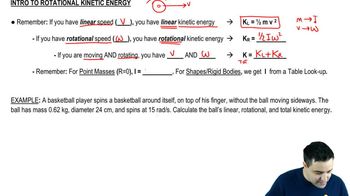
Intro to Rotational Kinetic Energy

Mass and Weight

Mass is a measure of the amount of matter in an object, typically measured in kilograms. In this scenario, the child's mass is 30 kg, which is essential for calculating kinetic energy. Understanding the relationship between mass and energy helps in assessing whether the child can reach the required speed to have 100 J of kinetic energy.
Video consigliato:
Percorso guidato
10:19
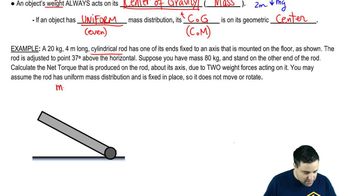
Torque Due to Weight

Velocity

Velocity is the speed of an object in a specific direction and is a vector quantity. To find out if the child can achieve 100 J of kinetic energy, we need to calculate the velocity using the kinetic energy formula. This involves rearranging the formula to solve for v, which will indicate if the child's running speed is feasible.
Video consigliato:
Percorso guidato
7:27
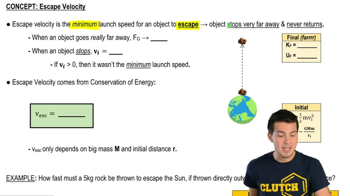
Escape Velocity
Pratica correlata
Domanda del libro di testo

A factory worker pushes a 30.030.0-kg crate a distance of 4.54.5 m along a level floor at constant velocity by pushing horizontally on it. The coefficient of kinetic friction between the crate and the floor is 0.250.25. What is the total work done on the crate?

2297
views
Domanda del libro di testo

A 1.501.50-kg book is sliding along a rough horizontal surface. At point AA it is moving at 3.213.21 m/s, and at point BB it has slowed to 1.251.25 m/s. How much work was done on the book between AA and BB?

3384
views
Domanda del libro di testo

A surgeon is using material from a donated heart to repair a patient's damaged aorta and needs to know the elastic characteristics of this aortal material. Tests performed on a 16.016.0-cm strip of the donated aorta reveal that it stretches 3.753.75 cm when a 1.501.50-N pull is exerted on it. What is the force constant of this strip of aortal material?

1578
views
Domanda del libro di testo

You throw a 3.003.00-N rock vertically into the air from ground level. You observe that when it is 15.015.0 m above the ground, it is traveling at 25.025.0 m/s upward. Use the work–energy theorem to find its maximum height.

2713
views
Domanda del libro di testo

Two tugboats pull a disabled supertanker. Each tug exerts a constant force of 1.80×1061.80\(\times\)10^6 N, one 14°14° west of north and the other 14°14° east of north, as they pull the tanker 0.750.75 km toward the north. What is the total work they do on the supertanker?

2954
views
Domanda del libro di testo

You throw a 3.003.00-N rock vertically into the air from ground level. You observe that when it is 15.015.0 m above the ground, it is traveling at 25.025.0 m/s upward. Use the work–energy theorem to find the rock's speed just as it left the ground.

7228
views
9
rank