
Ch 09: Rotation of Rigid Bodies
Young & Freedman Calc - University Physics 14th Edition
Young & Freedman Calc14th EditionUniversity PhysicsISBN: 9780321973610Non è quello che usi tu?Cambia libro di testo
Capitolo 9, Problema 51

A thin, rectangular sheet of metal has mass M and sides of length a and b. Use the parallel-axis theorem to calculate the moment of inertia of the sheet for an axis that is perpendicular to the plane of the sheet and that passes through one corner of the sheet.

Guida verificata passo dopo passo
1
Start by recalling the formula for the moment of inertia of a rectangular sheet about an axis perpendicular to its plane and passing through its center of mass. This is given by \( I_{\text{cm}} = \frac{1}{12} M (a^2 + b^2) \), where \( M \) is the mass of the sheet, and \( a \) and \( b \) are the lengths of its sides.
Next, recall the parallel-axis theorem, which states that the moment of inertia about any axis parallel to the center of mass axis is given by \( I = I_{\text{cm}} + M d^2 \), where \( d \) is the perpendicular distance between the two axes.
In this problem, the axis of rotation passes through one corner of the sheet. The distance \( d \) between the center of mass and this corner is the diagonal of the rectangle divided by 2. Using the Pythagorean theorem, the diagonal is \( \sqrt{a^2 + b^2} \), so \( d = \frac{1}{2} \sqrt{a^2 + b^2} \).
Substitute \( d \) into the parallel-axis theorem formula: \( I = \frac{1}{12} M (a^2 + b^2) + M \left( \frac{1}{2} \sqrt{a^2 + b^2} \right)^2 \).
Simplify the expression by squaring \( \frac{1}{2} \sqrt{a^2 + b^2} \) to get \( \frac{1}{4} (a^2 + b^2) \), and combine terms to find the total moment of inertia \( I \).

Risposta video verificata per un problema simile:

Questa soluzione video è stata consigliata dai nostri tutor come utile per risolvere questo problema.
Durata del video:
3m

Concetti chiave

Ecco i concetti essenziali che devi comprendere per rispondere correttamente alla domanda.

Moment of Inertia

Moment of inertia is a measure of an object's resistance to rotational motion about an axis. It depends on the mass distribution relative to the axis of rotation. For a thin rectangular sheet, the moment of inertia can be calculated using specific formulas that account for its shape and mass.
Video consigliato:
Percorso guidato
11:47
Intro to Moment of Inertia

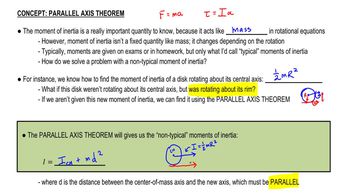
Parallel-Axis Theorem

The parallel-axis theorem states that the moment of inertia of a body about any axis parallel to an axis through its center of mass can be found by adding the product of the mass and the square of the distance between the two axes to the moment of inertia about the center of mass axis. This theorem is essential for calculating the moment of inertia when the axis of rotation does not pass through the center of mass.
Video consigliato:
Percorso guidato
13:46
Parallel Axis Theorem

Rectangular Sheet Properties

A thin rectangular sheet has specific geometric properties that influence its moment of inertia. The dimensions (length a and width b) and mass M are critical in determining how the mass is distributed across the sheet. Understanding these properties allows for the application of the moment of inertia formulas relevant to rectangular shapes.
Video consigliato:
Percorso guidato
08:45
Properties of Cyclic Thermodynamic Processes
Pratica correlata