
Ch 09: Rotation of Rigid Bodies
Young & Freedman Calc - University Physics 14th Edition
Young & Freedman Calc14th EditionUniversity PhysicsISBN: 9780321973610Non è quello che usi tu?Cambia libro di testo
Capitolo 9, Problema 52a

A thin uniform rod of mass M and length L is bent at its center so that the two segments are now perpendicular to each other. Find its moment of inertia about an axis perpendicular to its plane and passing through the point where the two segments meet.

Guida verificata passo dopo passo
1
Divide the rod into two segments, each of length L/2, since the rod is bent at its center. Each segment is treated as a straight, uniform rod.
Recall the formula for the moment of inertia of a thin uniform rod about an axis perpendicular to its length and passing through one end: \( I = \frac{1}{3} m L^2 \), where \( m \) is the mass of the rod and \( L \) is its length.
For each segment, the mass is \( M/2 \) (since the total mass \( M \) is evenly distributed), and the length is \( L/2 \). Substitute these values into the formula for the moment of inertia of each segment: \( I_{segment} = \frac{1}{3} \frac{M}{2} \left( \frac{L}{2} \right)^2 \).
Since the two segments are perpendicular to each other, their moments of inertia about the given axis are additive. Add the contributions from both segments to find the total moment of inertia: \( I_{total} = 2 \cdot I_{segment} \).
Simplify the expression for \( I_{total} \) by substituting \( I_{segment} \) and performing algebraic simplifications to express the final result in terms of \( M \) and \( L \).

Risposta video verificata per un problema simile:

Questa soluzione video è stata consigliata dai nostri tutor come utile per risolvere questo problema.
Durata del video:
2m

Concetti chiave

Ecco i concetti essenziali che devi comprendere per rispondere correttamente alla domanda.

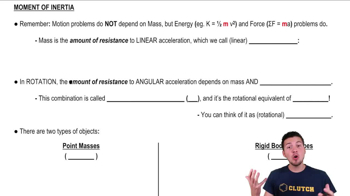
Moment of Inertia

Moment of inertia is a measure of an object's resistance to changes in its rotational motion about a specific axis. It depends on the mass distribution relative to that axis; the further the mass is from the axis, the greater the moment of inertia. For composite shapes, the total moment of inertia can be calculated by summing the contributions from individual parts, often using the parallel axis theorem.
Video consigliato:
Percorso guidato
11:47
Intro to Moment of Inertia

Parallel Axis Theorem

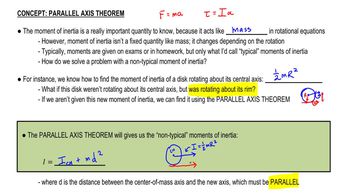
The parallel axis theorem allows us to calculate the moment of inertia of a body about any axis parallel to an axis through its center of mass. It states that the moment of inertia about the new axis is equal to the moment of inertia about the center of mass axis plus the product of the mass and the square of the distance between the two axes. This theorem is particularly useful for complex shapes or systems of particles.
Video consigliato:
Percorso guidato
13:46
Parallel Axis Theorem

Composite Shapes

Composite shapes are formed by combining two or more simple geometric shapes. To find the moment of inertia of a composite shape, one can calculate the moment of inertia for each individual shape about the same axis and then sum these values. Understanding how to break down complex shapes into simpler components is essential for accurately determining their overall moment of inertia.
Video consigliato:
Percorso guidato
07:47
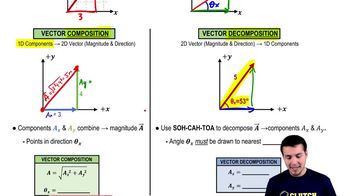
Vector Composition & Decomposition