
Ch 10: Dynamics of Rotational Motion
Young & Freedman Calc - University Physics 14th Edition
Young & Freedman Calc14th EditionUniversity PhysicsISBN: 9780321973610Non è quello che usi tu?Cambia libro di testo
Capitolo 10, Problema 16b

A 12.0-kg box resting on a horizontal, frictionless surface is attached to a 5.00-kg weight by a thin, light wire that passes over a frictionless pulley (Fig. E10.16). The pulley has the shape of a uniform solid disk of mass 2.00 kg and diameter 0.500 m. After the system is released, find the acceleration of the box.

Guida verificata passo dopo passo
1
Identify the forces acting on the system: The 5.00-kg weight experiences a gravitational force downward, which is the driving force for the system. The tension in the wire acts upward on the 5.00-kg weight and horizontally on the 12.0-kg box.
Apply Newton's second law to the 5.00-kg weight: The net force on the weight is the difference between the gravitational force and the tension in the wire. This can be expressed as: \( m_2 g - T = m_2 a \), where \( m_2 = 5.00 \text{ kg} \), \( g = 9.81 \text{ m/s}^2 \), and \( a \) is the acceleration.
Apply Newton's second law to the 12.0-kg box: The only horizontal force on the box is the tension in the wire, so \( T = m_1 a \), where \( m_1 = 12.0 \text{ kg} \).
Consider the rotational motion of the pulley: The torque on the pulley due to the tension is \( \tau = T R \), where \( R = 0.250 \text{ m} \) is the radius of the pulley. The moment of inertia of the pulley is \( I = \frac{1}{2} m R^2 \), where \( m = 2.00 \text{ kg} \). The angular acceleration \( \alpha \) is related to the linear acceleration by \( \alpha = \frac{a}{R} \).
Combine the equations: Use the relationship between torque and angular acceleration \( \tau = I \alpha \) to find \( T \) in terms of \( a \). Substitute this expression into the equations for the 5.00-kg weight and the 12.0-kg box to solve for the acceleration \( a \).

Risposta video verificata per un problema simile:

Questa soluzione video è stata consigliata dai nostri tutor come utile per risolvere questo problema.
Durata del video:
17m

Concetti chiave

Ecco i concetti essenziali che devi comprendere per rispondere correttamente alla domanda.

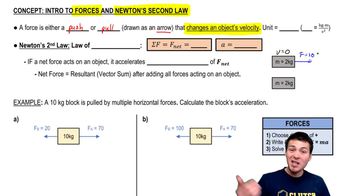
Newton's Second Law

Newton's Second Law states that the acceleration of an object is directly proportional to the net force acting on it and inversely proportional to its mass (F = ma). In this problem, it helps determine the acceleration of the box by considering the forces acting on both the box and the weight, including gravitational force and tension in the wire.
Video consigliato:
Percorso guidato
06:54
Intro to Forces & Newton's Second Law

Rotational Dynamics

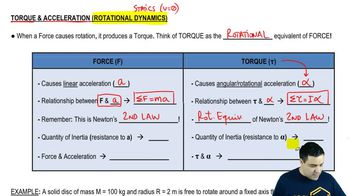
Rotational dynamics involves the study of objects in rotational motion, where torque and angular acceleration play key roles. The pulley in this problem is a solid disk, and its rotational inertia affects the system's dynamics. Understanding how the torque due to the tension in the wire causes angular acceleration in the pulley is crucial for solving the problem.
Video consigliato:
Percorso guidato
08:12
Torque & Acceleration (Rotational Dynamics)

Conservation of Energy

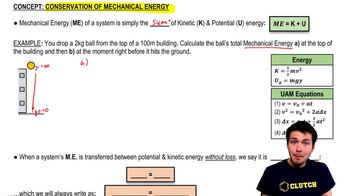
Conservation of energy states that energy in a closed system remains constant. In this scenario, the potential energy of the weight is converted into kinetic energy of the box and rotational kinetic energy of the pulley. Analyzing energy transformations helps in understanding the system's behavior and calculating the acceleration of the box.
Video consigliato:
Percorso guidato
06:24
Conservation Of Mechanical Energy
Pratica correlata
Domanda del libro di testo

A 2.20-kg hoop 1.20 m in diameter is rolling to the right without slipping on a horizontal floor at a steady 2.60 rad/s. Find the velocity vector of each of the following points, as viewed by a person at rest on the ground: (i) the highest point on the hoop; (ii) the lowest point on the hoop; (iii) a point on the right side of the hoop, midway between the top and the bottom.

2922
views
Domanda del libro di testo

A 2.00-kg textbook rests on a frictionless, horizontal surface. A cord attached to the book passes over a pulley whose diameter is 0.150 m, to a hanging book with mass 3.00 kg. The system is released from rest, and the books are observed to move 1.20 m in 0.800 s. What is the tension in each part of the cord?

2780
views
2
rank
Domanda del libro di testo

A solid ball is released from rest and slides down a hillside that slopes downward at 65.0° from the horizontal. In part (a), why did we use the coefficient of static friction and not the coefficient of kinetic friction?

1302
views
Domanda del libro di testo

A stone is suspended from the free end of a wire that is wrapped around the outer rim of a pulley, similar to what is shown in Fig. 10.10. The pulley is a uniform disk with mass 10.0 kg and radius 30.0 cm and turns on frictionless bearings. You measure that the stone travels 12.6 m in the first 3.00 s starting from rest. Find the tension in the wire.

4414
views
1
rank
1
comments
Domanda del libro di testo

A 2.20-kg hoop 1.20 m in diameter is rolling to the right without slipping on a horizontal floor at a steady 2.60 rad/s. Find the velocity vector for each of the points in part (c), but this time as viewed by someone moving along with the same velocity as the hoop.

1667
views
Domanda del libro di testo

A 15.0-kg bucket of water is suspended by a very light rope wrapped around a solid uniform cylinder 0.300 m in diameter with mass 12.0 kg. The cylinder pivots on a frictionless axle through its center. The bucket is released from rest at the top of a well and falls 10.0 m to the water. With what speed does the bucket strike the water?

3068
views