
Ch 10: Dynamics of Rotational Motion
Young & Freedman Calc - University Physics 14th Edition
Young & Freedman Calc14th EditionUniversity PhysicsISBN: 9780321973610Non è quello che usi tu?Cambia libro di testo
Capitolo 10, Problema 17d

A 2.20-kg hoop 1.20 m in diameter is rolling to the right without slipping on a horizontal floor at a steady 2.60 rad/s. Find the velocity vector for each of the points in part (c), but this time as viewed by someone moving along with the same velocity as the hoop.

Guida verificata passo dopo passo
1
First, understand that the problem involves a hoop rolling without slipping, which means the linear velocity of the center of mass is equal to the tangential velocity at the rim due to rotation. The hoop's diameter is 1.20 m, so its radius \( r \) is 0.60 m.
Calculate the linear velocity \( v \) of the center of mass of the hoop using the relation \( v = r \cdot \omega \), where \( \omega \) is the angular velocity. Here, \( \omega = 2.60 \) rad/s and \( r = 0.60 \) m.
Since the observer is moving with the same velocity as the hoop, the relative velocity of the center of mass with respect to the observer is zero. Therefore, the observer sees the hoop as if it is rotating in place.
For each point on the hoop, calculate the velocity vector relative to the observer. The velocity of any point on the hoop is given by \( \mathbf{v} = \mathbf{v}_{\text{cm}} + \mathbf{v}_{\text{rot}} \), where \( \mathbf{v}_{\text{cm}} \) is the velocity of the center of mass and \( \mathbf{v}_{\text{rot}} \) is the rotational component. Since \( \mathbf{v}_{\text{cm}} = 0 \) for the observer, only \( \mathbf{v}_{\text{rot}} \) needs to be considered.
The rotational velocity \( \mathbf{v}_{\text{rot}} \) at any point on the hoop is perpendicular to the radius and has a magnitude \( v_{rot} = r \cdot \omega \). For points on the hoop, determine the direction of \( \mathbf{v}_{\text{rot}} \) based on their position relative to the center of mass, considering the hoop's rotation direction.

Risposta video verificata per un problema simile:

Questa soluzione video è stata consigliata dai nostri tutor come utile per risolvere questo problema.
Durata del video:
7m

Concetti chiave

Ecco i concetti essenziali che devi comprendere per rispondere correttamente alla domanda.

Rolling Motion

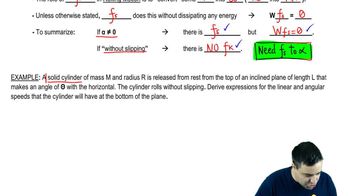
Rolling motion involves both translational and rotational movement. For a hoop rolling without slipping, the point of contact with the ground is momentarily at rest relative to the ground. The linear velocity of the center of mass is related to the angular velocity by v = rω, where r is the radius and ω is the angular velocity.
Video consigliato:
Percorso guidato
12:26
Conservation of Energy in Rolling Motion

Relative Velocity

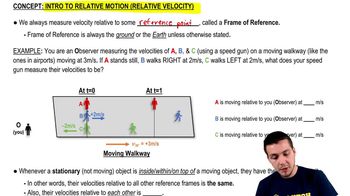
Relative velocity is the velocity of an object as observed from a moving reference frame. To find the velocity of points on the hoop from the perspective of someone moving with the hoop, subtract the velocity of the observer from the velocity of each point. This simplifies the problem by considering the motion relative to the hoop's center.
Video consigliato:
Percorso guidato
04:27
Intro to Relative Motion (Relative Velocity)

Velocity Vector

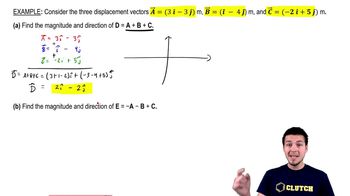
A velocity vector represents both the magnitude and direction of an object's velocity. For points on a rolling hoop, the velocity vector combines the translational motion of the hoop's center and the rotational motion around the center. Analyzing these vectors helps determine the motion of specific points relative to a moving observer.
Video consigliato:
Percorso guidato
06:44
Adding 3 Vectors in Unit Vector Notation
Pratica correlata
Domanda del libro di testo

A 2.20-kg hoop 1.20 m in diameter is rolling to the right without slipping on a horizontal floor at a steady 2.60 rad/s. Find the velocity vector of each of the following points, as viewed by a person at rest on the ground: (i) the highest point on the hoop; (ii) the lowest point on the hoop; (iii) a point on the right side of the hoop, midway between the top and the bottom.

2922
views
Domanda del libro di testo

A bicycle racer is going downhill at 11.0 m/s when, to his horror, one of his 2.25-kg wheels comes off as he is 75.0 m above the foot of the hill. We can model the wheel as a thin-walled cylinder 85.0 cm in diameter and ignore the small mass of the spokes. How much total kinetic energy does the wheel have when it reaches the bottom of the hill?

1485
views
Domanda del libro di testo

A solid ball is released from rest and slides down a hillside that slopes downward at 65.0° from the horizontal. In part (a), why did we use the coefficient of static friction and not the coefficient of kinetic friction?

1302
views
Domanda del libro di testo

A 15.0-kg bucket of water is suspended by a very light rope wrapped around a solid uniform cylinder 0.300 m in diameter with mass 12.0 kg. The cylinder pivots on a frictionless axle through its center. The bucket is released from rest at the top of a well and falls 10.0 m to the water. With what speed does the bucket strike the water?

3068
views
Domanda del libro di testo

A 12.0-kg box resting on a horizontal, frictionless surface is attached to a 5.00-kg weight by a thin, light wire that passes over a frictionless pulley (Fig. E10.16). The pulley has the shape of a uniform solid disk of mass 2.00 kg and diameter 0.500 m. After the system is released, find the acceleration of the box.

7372
views
Domanda del libro di testo

A playground merry-go-round has radius 2.40 m2.40\(\text{ m}\) and moment of inertia 2100 kg m22100\(\text{ kg m}\)^2 about a vertical axle through its center, and it turns with negligible friction. A child applies an 18.0 N18.0\(\text{ N}\) force tangentially to the edge of the merry-go-round for 15.0 s15.0\(\text{ s}\). If the merry-go-round is initially at rest, what is its angular speed after this 15.0 s15.0\(\text{ s}\) interval?

1347
views