

Ch 14: Periodic Motion
Young & Freedman Calc - University Physics 14th Edition
Young & Freedman Calc14th EditionUniversity PhysicsISBN: 9780321973610Non è quello che usi tu?Cambia libro di testo
Capitolo 14, Problema 18

A 0.400-kg object undergoing SHM has ax = -1.80 m/s2 when x = 0.300 m. What is the time for one oscillation?

Guida verificata passo dopo passo
1
Start by identifying the formula for acceleration in simple harmonic motion (SHM), which is given by: a = -ω2x, where ω is the angular frequency and x is the displacement.
Substitute the given values into the formula: -1.80 = -ω2×0.300. Solve for ω2.
Calculate ω2 by rearranging the equation: ω2 = 1.800.300.
Find the angular frequency ω by taking the square root of ω2: ω = 1.800.300.
Use the relationship between angular frequency and period: T = 2πω, where T is the period of one oscillation. Substitute the value of ω to find T.

Risposta video verificata per un problema simile:

Questa soluzione video è stata consigliata dai nostri tutor come utile per risolvere questo problema.
Durata del video:
4m

Concetti chiave

Ecco i concetti essenziali che devi comprendere per rispondere correttamente alla domanda.

Simple Harmonic Motion (SHM)

Simple Harmonic Motion is a type of periodic motion where the restoring force is directly proportional to the displacement and acts in the opposite direction. It is characterized by oscillations around an equilibrium position, such as a mass on a spring or a pendulum.
Video consigliato:
Percorso guidato
07:52
Simple Harmonic Motion of Pendulums

Acceleration in SHM

In SHM, acceleration is given by the equation a = -ω²x, where ω is the angular frequency and x is the displacement from the equilibrium position. The negative sign indicates that the acceleration is always directed towards the equilibrium position, opposing the displacement.
Video consigliato:
Percorso guidato
05:47
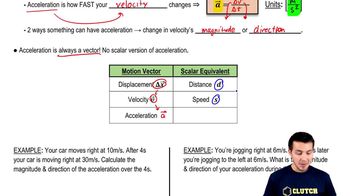
Intro to Acceleration

Period of Oscillation

The period of oscillation, T, is the time taken for one complete cycle of motion in SHM. It is related to the angular frequency by the formula T = 2π/ω. Knowing the acceleration and displacement, one can find ω and subsequently calculate the period.
Video consigliato:
Percorso guidato
06:28
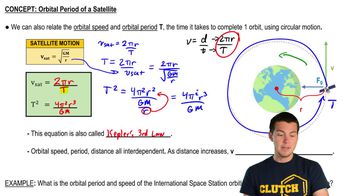
Satellite Period
Pratica correlata
Domanda del libro di testo

A small block is attached to an ideal spring and is moving in SHM on a horizontal, frictionless surface. When the amplitude of the motion is 0.090 m, it takes the block 2.70 s to travel from x = 0.090 m to x = -0.090 m. If the amplitude is doubled, to 0.180 m, how long does it take the block to travel from x = 0.180 m to x = -0.180 m?

2809
views
Domanda del libro di testo

For the oscillating object in Fig. E14.4, what is its maximum speed?

2163
views
Domanda del libro di testo

A 0.500kg0.500\(\operatorname{kg}\) mass on a spring has velocity as a function of time given by vx(t)=−(3.60cm/s)sin[(4.7 rad/s)t−(π/2)]v_{x}(t)=-(3.60\(\operatorname{cm}\)/s)\(\sin\)[(4.7\(\text{ }\)rad/s)t-(\(\pi\)/2)]. What are the period and the force constant of the spring?

1593
views
Domanda del libro di testo

A small block is attached to an ideal spring and is moving in SHM on a horizontal, frictionless surface. When the amplitude of the motion is 0.090 m, it takes the block 2.70 s to travel from x = 0.090 m to x = -0.090 m. If the amplitude is doubled, to 0.180 m, how long does it take the block to travel from x = 0.090 m to x = -0.090 m?

1748
views
Domanda del libro di testo

Weighing Astronauts. This procedure has been used to 'weigh' astronauts in space: A 42.5-kg chair is attached to a spring and allowed to oscillate. When it is empty, the chair takes 1.30 s to make one complete vibration. But with an astronaut sitting in it, with her feet off the floor, the chair takes 2.54 s for one cycle. What is the mass of the astronaut?

1714
views
Domanda del libro di testo

A 0.500kg0.500\(\operatorname{kg}\) mass on a spring has velocity as a function of time given by vx(t)=−(3.60cm/s)sin[(4.7 rad/s)t−(π/2)]v_{x}(t)=-(3.60\(\operatorname{cm}\)/s)\(\sin\)[(4.7\(\text{ }\)rad/s)t-(\(\pi\)/2)]. What are the amplitude and the maximum acceleration of the mass?

2484
views