Ch 14: Periodic Motion
Young & Freedman Calc - University Physics 14th Edition
Young & Freedman Calc14th EditionUniversity PhysicsISBN: 9780321973610Non è quello che usi tu?Cambia libro di testo
Capitolo 14, Problema 47

A building in San Francisco has light fixtures consisting of small 2.35-kg bulbs with shades hanging from the ceiling at the end of light, thin cords 1.50 m long. If a minor earthquake occurs, how many swings per second will these fixtures make?

Guida verificata passo dopo passo
1
Identify the problem as a simple pendulum problem, where the light fixture acts as a pendulum bob. The frequency of a simple pendulum depends on the length of the pendulum and the acceleration due to gravity.
Recall the formula for the period of a simple pendulum: T=2πlg, where l is the length of the pendulum and g is the acceleration due to gravity (approximately 9.81 m/s²).
Substitute the given length of the cord, l=1.50 m, into the period formula: T=2π1.509.81.
Calculate the period T using the formula. This will give you the time it takes for one complete swing back and forth.
Determine the frequency of the pendulum, which is the number of swings per second, by taking the reciprocal of the period: f=1T.

Risposta video verificata per un problema simile:

Questa soluzione video è stata consigliata dai nostri tutor come utile per risolvere questo problema.
Durata del video:
2m

Concetti chiave

Ecco i concetti essenziali che devi comprendere per rispondere correttamente alla domanda.

Simple Harmonic Motion

Simple harmonic motion describes the oscillatory motion of objects like pendulums, where the restoring force is proportional to the displacement. In this context, the light fixtures act as pendulums, swinging back and forth due to gravitational forces, which can be modeled using the principles of simple harmonic motion.
Video consigliato:
Percorso guidato
07:52
Simple Harmonic Motion of Pendulums

Pendulum Formula

The period of a simple pendulum is determined by the formula T = 2π√(L/g), where T is the period, L is the length of the pendulum, and g is the acceleration due to gravity. This formula helps calculate the time it takes for one complete swing, which is essential for determining the frequency of oscillation during an earthquake.
Video consigliato:
Percorso guidato
06:53
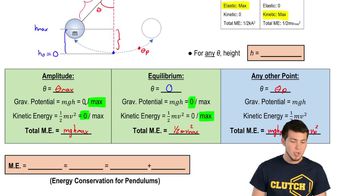
Energy in Pendulums

Frequency of Oscillation

Frequency refers to the number of complete cycles or swings per second, calculated as the inverse of the period (f = 1/T). Understanding frequency is crucial for determining how many swings per second the light fixtures will make during an earthquake, providing insight into their oscillatory behavior.
Video consigliato:
Percorso guidato
05:08
Circumference, Period, and Frequency in UCM
Pratica correlata
Domanda del libro di testo

A certain simple pendulum has a period on the earth of 1.60 s. What is its period on the surface of Mars, where g = 3.71 m/s2?

2144
views

Domanda del libro di testo

You pull a simple pendulum 0.240 m long to the side through an angle of 3.50° and release it. How much time does it take the pendulum bob to reach its highest speed?

1929
views
Domanda del libro di testo

You pull a simple pendulum 0.240 m long to the side through an angle of 3.50° and release it. How much time does it take if the pendulum is released at an angle of 1.75° instead of 3.50°?

1462
views
Domanda del libro di testo

A thrill-seeking cat with mass 4.00 kg is attached by a harness to an ideal spring of negligible mass and oscillates vertically in SHM. The amplitude is 0.050 m, and at the highest point of the motion the spring has its natural unstretched length. Calculate the elastic potential energy of the spring (take it to be zero for the unstretched spring), the kinetic energy of the cat, the gravitational potential energy of the system relative to the lowest point of the motion, and the sum of these three energies when the cat is at its highest point.

3635
views
Domanda del libro di testo

A simple pendulum 2.00 m long swings through a maximum angle of 30.0° with the vertical. Calculate its period (a) assuming a small amplitude, and (b) using the first three terms of Eq. (14.35). (c) Which of the answers in parts (a) and (b) is more accurate? What is the percentage error of the less accurate answer compared with the more accurate one?

1800
views
Domanda del libro di testo

A simple pendulum 2.00 m long swings through a maximum angle of 30.0° with the vertical. Calculate its period (a) assuming a small amplitude, and (b) using the first three terms of Eq. (14.35).

1657
views