Ch 14: Periodic Motion
Young & Freedman Calc - University Physics 14th Edition
Young & Freedman Calc14th EditionUniversity PhysicsISBN: 9780321973610Non è quello che usi tu?Cambia libro di testo
Capitolo 14, Problema 51c

A simple pendulum 2.00 m long swings through a maximum angle of 30.0° with the vertical. Calculate its period (a) assuming a small amplitude, and (b) using the first three terms of Eq. (14.35). (c) Which of the answers in parts (a) and (b) is more accurate? What is the percentage error of the less accurate answer compared with the more accurate one?

Guida verificata passo dopo passo
1
Step 1: Understand the problem. We need to calculate the period of a simple pendulum with a length of 2.00 m and a maximum angle of 30.0° with the vertical. We will do this in two ways: (a) assuming a small amplitude, and (b) using the first three terms of a given equation (Eq. 14.35). Finally, we will compare the accuracy of both methods.
Step 2: For part (a), use the formula for the period of a simple pendulum assuming small amplitude: T=2π√lg, where l is the length of the pendulum and g is the acceleration due to gravity (approximately 9.81 m/s²). Substitute the given values into this formula.
Step 3: For part (b), use the first three terms of Eq. (14.35) to calculate the period. This equation accounts for larger amplitudes and is typically expressed as: T=2π√lg(1+116⁡θ2+113072⁡θ4), where θ is the maximum angle in radians. Convert 30.0° to radians and substitute into the equation.
Step 4: Compare the results from parts (a) and (b). The method in part (b) is more accurate because it accounts for the larger amplitude of the pendulum swing. Calculate the percentage error of the less accurate answer (from part (a)) compared to the more accurate answer (from part (b)) using the formula: Percentage Error=|T_a-T_b|T_b×100, where T_a and T_b are the periods calculated in parts (a) and (b), respectively.
Step 5: Reflect on the importance of considering amplitude in pendulum calculations. For small angles, the simple formula is sufficient, but for larger angles, corrections are necessary to ensure accuracy. This highlights the importance of understanding the limitations of approximations in physics.

Risposta video verificata per un problema simile:

Questa soluzione video è stata consigliata dai nostri tutor come utile per risolvere questo problema.
Durata del video:
9m

Concetti chiave

Ecco i concetti essenziali che devi comprendere per rispondere correttamente alla domanda.

Simple Harmonic Motion

Simple harmonic motion (SHM) describes the motion of oscillating systems like pendulums, where the restoring force is directly proportional to the displacement. For small angles, a simple pendulum exhibits SHM, allowing us to use the formula T = 2π√(L/g) to calculate its period, where L is the length and g is the acceleration due to gravity.
Video consigliato:
Percorso guidato
07:52
Simple Harmonic Motion of Pendulums

Pendulum Period Formula

The period of a simple pendulum for small angles is given by T = 2π√(L/g). This formula assumes that the angle of swing is small enough for the approximation sin(θ) ≈ θ to hold true, which simplifies the motion to SHM. This approximation is valid for angles typically less than about 15°.
Video consigliato:
Percorso guidato
06:53
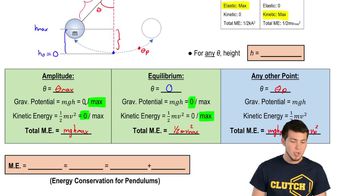
Energy in Pendulums

Nonlinear Pendulum Motion

For larger angles, the simple pendulum does not follow SHM precisely, and corrections are needed. The period can be calculated using a series expansion, such as Eq. (14.35), which includes higher-order terms to account for the nonlinearity. This provides a more accurate period for larger amplitudes, reducing the error from the small-angle approximation.
Video consigliato:
Percorso guidato
07:52
Simple Harmonic Motion of Pendulums