Ch 14: Periodic Motion
Young & Freedman Calc - University Physics 14th Edition
Young & Freedman Calc14th EditionUniversity PhysicsISBN: 9780321973610Non è quello che usi tu?Cambia libro di testo
Capitolo 14, Problema 25

A small block is attached to an ideal spring and is moving in SHM on a horizontal frictionless surface. The amplitude of the motion is 0.165 m. The maximum speed of the block is 3.90 m/s. What is the maximum magnitude of the acceleration of the block?

Guida verificata passo dopo passo
1
Start by recalling the relationship between maximum speed, amplitude, and angular frequency in simple harmonic motion (SHM). The maximum speed \( v_{max} \) is given by \( v_{max} = A \omega \), where \( A \) is the amplitude and \( \omega \) is the angular frequency.
Use the given values: amplitude \( A = 0.165 \) m and maximum speed \( v_{max} = 3.90 \) m/s to solve for the angular frequency \( \omega \). Rearrange the formula to \( \omega = \frac{v_{max}}{A} \).
Calculate \( \omega \) using the values provided: \( \omega = \frac{3.90}{0.165} \). This will give you the angular frequency in radians per second.
Recall that the maximum acceleration \( a_{max} \) in SHM is given by \( a_{max} = A \omega^2 \). This formula relates the amplitude and the square of the angular frequency to the maximum acceleration.
Substitute the values of \( A \) and \( \omega \) into the formula \( a_{max} = A \omega^2 \) to find the maximum magnitude of the acceleration. This will give you the desired result.

Risposta video verificata per un problema simile:

Questa soluzione video è stata consigliata dai nostri tutor come utile per risolvere questo problema.
Durata del video:
3m

Concetti chiave

Ecco i concetti essenziali che devi comprendere per rispondere correttamente alla domanda.

Simple Harmonic Motion (SHM)

Simple Harmonic Motion (SHM) is a type of periodic motion where an object oscillates back and forth through an equilibrium position. The motion is characterized by a restoring force proportional to the displacement from equilibrium, often described by sine or cosine functions. In SHM, the object experiences maximum speed at the equilibrium position and maximum acceleration at the points of maximum displacement.
Video consigliato:
Percorso guidato
07:52
Simple Harmonic Motion of Pendulums

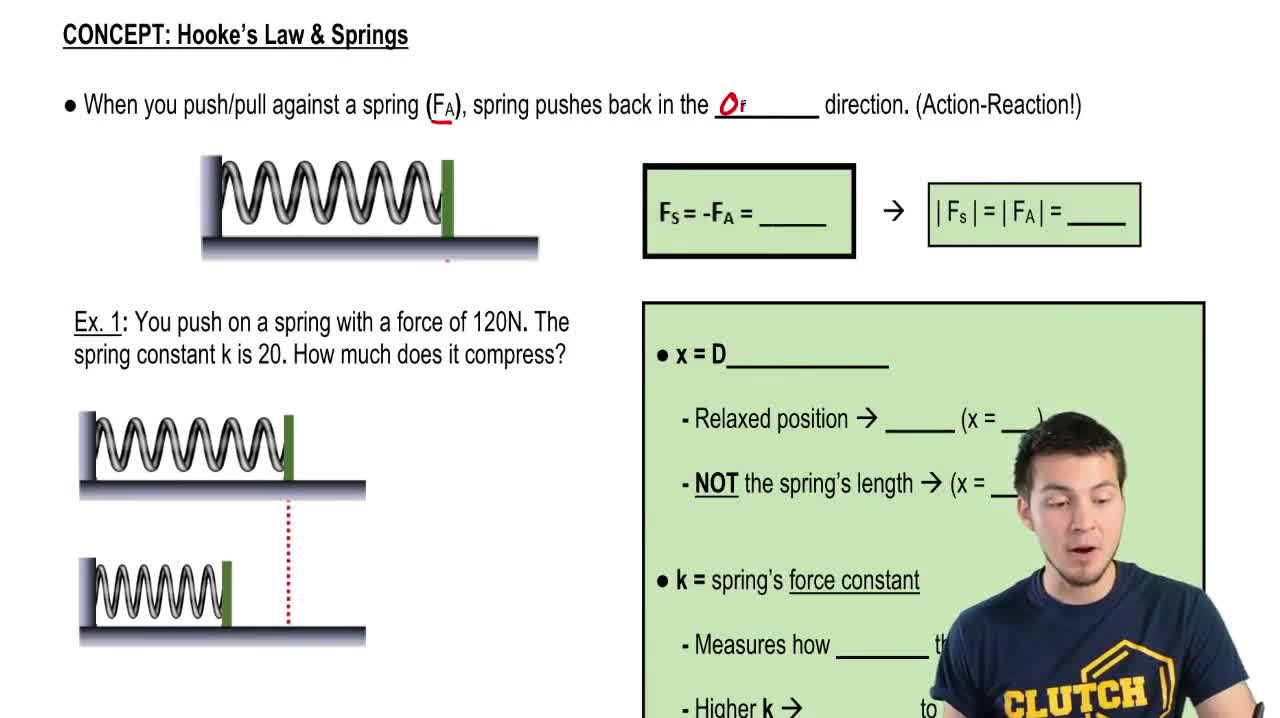
Hooke's Law

Hooke's Law states that the force exerted by a spring is directly proportional to the displacement from its equilibrium position, expressed as F = -kx, where k is the spring constant and x is the displacement. This law is fundamental in understanding the restoring force in SHM, as it explains how the spring's force changes with displacement, influencing the motion's amplitude and frequency.
Video consigliato:
Percorso guidato
05:27
Spring Force (Hooke's Law)

Relationship between Speed, Amplitude, and Acceleration in SHM

In SHM, the maximum speed (v_max) and maximum acceleration (a_max) are related to the amplitude (A) and angular frequency (ω) of the motion. The maximum speed is given by v_max = Aω, and the maximum acceleration is a_max = Aω². These relationships help determine the maximum acceleration by using the given amplitude and maximum speed to find the angular frequency, which is crucial for solving the problem.
Video consigliato:
Percorso guidato
03:43
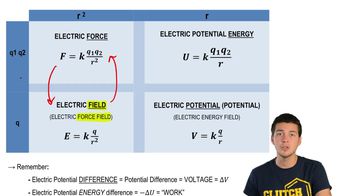
Relationships Between Force, Field, Energy, Potential