

Ch 16: Sound & Hearing
Young & Freedman Calc - University Physics 14th Edition
Young & Freedman Calc14th EditionUniversity PhysicsISBN: 9780321973610Non è quello che usi tu?Cambia libro di testo
Capitolo 16, Problema 6b

A metal bar with a length of 1.50 m has density 6400 kg/m3. Longitudinal sound waves take 3.90 × 10⁻⁴ s to travel from one end of the bar to the other. What is Young's modulus for this metal?

Guida verificata passo dopo passo
1
First, understand that Young's modulus (E) is a measure of the stiffness of a material and is defined as the ratio of stress to strain. In this problem, we can use the relationship between the speed of sound in a material, its density, and Young's modulus.
The speed of sound (v) in a material is given by the formula: v=Eρ, where E is Young's modulus and ρ is the density of the material.
Calculate the speed of sound in the metal bar using the formula: v=Lt, where L is the length of the bar (1.50 m) and t is the time taken for the sound to travel (3.90 * 10-4 s).
Substitute the calculated speed of sound and the given density into the formula for the speed of sound: v=Eρ. Rearrange this equation to solve for Young's modulus: E=v^2ρ.
Finally, calculate Young's modulus using the values obtained for the speed of sound and the given density of the metal. This will give you the stiffness of the metal in terms of Young's modulus.

Risposta video verificata per un problema simile:

Questa soluzione video è stata consigliata dai nostri tutor come utile per risolvere questo problema.
Durata del video:
3m

Concetti chiave

Ecco i concetti essenziali che devi comprendere per rispondere correttamente alla domanda.

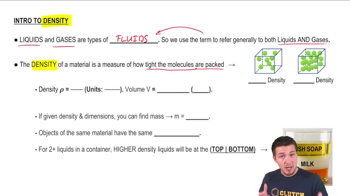
Density

Density is a measure of mass per unit volume, expressed in kg/m³. It is crucial for calculating the speed of sound in a material, as it affects how tightly packed the particles are, influencing how sound waves propagate through the medium.
Video consigliato:
Percorso guidato
8:13
Intro to Density

Speed of Sound in Solids

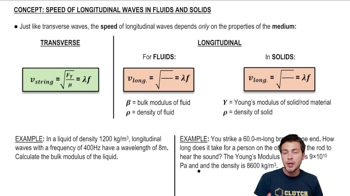
The speed of sound in a solid is determined by the material's density and its elastic properties, specifically Young's modulus. It is calculated using the formula v = √(E/ρ), where v is the speed of sound, E is Young's modulus, and ρ is the density. This relationship helps in determining how quickly sound waves travel through the material.
Video consigliato:
Percorso guidato
05:40
Speed of Longitudinal Waves (Fluids & Solids)

Young's Modulus

Young's modulus is a measure of the stiffness of a material, defined as the ratio of stress to strain in the linear elasticity regime of a uniaxial deformation. It is expressed in pascals (Pa) and is essential for understanding how a material deforms under stress, influencing the speed of sound in the material.
Video consigliato:
Percorso guidato
12:00
Young's Double Slit Experiment
Pratica correlata
Domanda del libro di testo

Sound is detected when a sound wave causes the tympanic membrane (the eardrum) to vibrate. Typically, the diameter of this membrane is about 8.4 mm in humans. How much energy is delivered to the eardrum each second when someone whispers (20 dB) a secret in your ear?

2578
views
Domanda del libro di testo

An oscillator vibrating at 1250 Hz produces a sound wave that travels through an ideal gas at 325 m/s when the gas temperature is 22.0°C. For a certain experiment, you need to have the same oscillator produce sound of wavelength 28.5 cm in this gas. What should the gas temperature be to achieve this wavelength?

1480
views
Domanda del libro di testo

Consider a sound wave in air that has displacement amplitude 0.0200 mm. Calculate the pressure amplitude for frequencies of (a) 150 Hz; (b) 1500 Hz; (c) 15,000 Hz. In each case compare the result to the pain threshold, which is 30 Pa.

2363
views
Domanda del libro di testo

A loud factory machine produces sound having a displacement amplitude of 1.00 mm, but the frequency of this sound can be adjusted. In order to prevent ear damage to the workers, the maximum pressure amplitude of the sound waves is limited to 10.0 Pa. Under the conditions of this factory, the bulk modulus of air is 1.42 × 10⁵ Pa. What is the highest-frequency sound to which this machine can be adjusted without exceeding the prescribed limit? Is this frequency audible to the workers?

1985
views
1
rank
Domanda del libro di testo

Example 16.1 (Section 16.1) showed that for sound waves in air with frequency 1000 Hz, a displacement amplitude of 1.2 × 10⁻⁸ m produces a pressure amplitude of 3.0 × 10⁻² Pa. What is the wavelength of these waves?

1154
views
Domanda del libro di testo

What must be the stress (F/A) in a stretched wire of a material whose Young's modulus is Y for the speed of longitudinal waves to equal 30 times the speed of transverse waves?

1293
views