
Ch 16: Sound & Hearing
Young & Freedman Calc - University Physics 14th Edition
Young & Freedman Calc14th EditionUniversity PhysicsISBN: 9780321973610Non è quello che usi tu?Cambia libro di testo
Capitolo 16, Problema 1a

Example 16.1 (Section 16.1) showed that for sound waves in air with frequency 1000 Hz, a displacement amplitude of 1.2 × 10⁻⁸ m produces a pressure amplitude of 3.0 × 10⁻² Pa. What is the wavelength of these waves?

Guida verificata passo dopo passo
1
Start by recalling the relationship between the speed of sound, frequency, and wavelength. The formula is: v=fλ, where v is the speed of sound, f is the frequency, and λ is the wavelength.
Identify the known values: the frequency f is given as 1000 Hz. The speed of sound in air at room temperature is approximately 343 m/s.
Rearrange the formula to solve for the wavelength: λ=vf.
Substitute the known values into the equation: λ=343 m/s1000 Hz.
Calculate the wavelength using the substituted values. This will give you the wavelength of the sound waves in meters.

Risposta video verificata per un problema simile:

Questa soluzione video è stata consigliata dai nostri tutor come utile per risolvere questo problema.
Durata del video:
3m

Concetti chiave

Ecco i concetti essenziali che devi comprendere per rispondere correttamente alla domanda.

Sound Waves

Sound waves are longitudinal waves that travel through a medium, such as air, by compressing and rarefying the particles in the medium. The frequency of a sound wave determines its pitch, while the amplitude affects its loudness. Understanding sound waves involves analyzing their properties, such as frequency, wavelength, and amplitude.
Video consigliato:
Percorso guidato
05:17
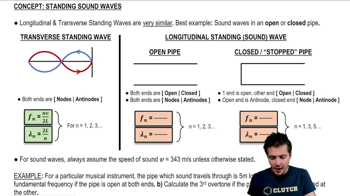
Standing Sound Waves

Frequency

Frequency is the number of oscillations or cycles a wave completes in one second, measured in Hertz (Hz). It is a crucial parameter in wave mechanics, influencing the energy and characteristics of the wave. In this context, a frequency of 1000 Hz indicates that the sound wave completes 1000 cycles per second.
Video consigliato:
Percorso guidato
05:08
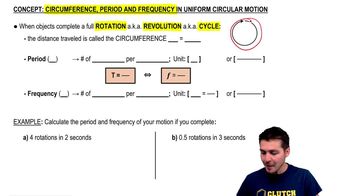
Circumference, Period, and Frequency in UCM

Wavelength

Wavelength is the distance between consecutive points of a wave that are in phase, such as crest to crest or trough to trough. It is inversely related to frequency, meaning higher frequency waves have shorter wavelengths. To find the wavelength, one can use the wave equation: wavelength = speed of sound / frequency.
Video consigliato:
Percorso guidato
05:42
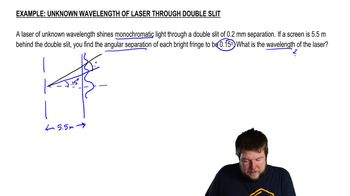
Unknown Wavelength of Laser through Double Slit