Ch 23: Electric Potential
Young & Freedman Calc - University Physics 14th Edition
Young & Freedman Calc14th EditionUniversity PhysicsISBN: 9780321973610Non è quello che usi tu?Cambia libro di testo
Capitolo 23, Problema 4

How much work would it take to push two protons very slowly from a separation of 2.00×10−102.00\(\times\)10^{-10} m (a typical atomic distance) to 3.00×10−153.00\(\times\)10^{-15} m (a typical nuclear distance)? If the protons are both released from rest at the closer distance in part (a), how fast are they moving when they reach their original separation?

Guida verificata passo dopo passo
1
Step 1: Understand the concept of electric potential energy. The work done in moving charges is related to the change in electric potential energy. For two point charges, the electric potential energy U is given by the formula: -kq1q2r, where k is Coulomb's constant, q1 and q2 are the charges, and r is the separation distance.
Step 2: Calculate the initial and final electric potential energy. Use the formula for electric potential energy to find the initial energy at 2.00x10^-10 m and the final energy at 3.00x10^-15 m. Remember that the charge of a proton is approximately 1.60x10^-19 C.
Step 3: Determine the work done. The work done in moving the protons is equal to the change in electric potential energy, which is the final potential energy minus the initial potential energy. Use the values calculated in Step 2 to find this difference.
Step 4: For part (b), apply the conservation of energy principle. When the protons are released from rest, their initial kinetic energy is zero, and their potential energy is at the closer distance. As they move apart, their potential energy decreases, and their kinetic energy increases.
Step 5: Calculate the final speed of the protons. Use the conservation of energy equation: Kf=Ui-Uf, where Kf is the final kinetic energy, Ui is the initial potential energy, and Uf is the final potential energy. Solve for the final speed using the relation between kinetic energy and speed: Kf=12mv2, where m is the mass of a proton.

Risposta video verificata per un problema simile:

Questa soluzione video è stata consigliata dai nostri tutor come utile per risolvere questo problema.
Durata del video:
7m

Concetti chiave

Ecco i concetti essenziali che devi comprendere per rispondere correttamente alla domanda.

Electrostatic Force

Electrostatic force is the force between charged particles, described by Coulomb's law. It states that the force is directly proportional to the product of the charges and inversely proportional to the square of the distance between them. Understanding this force is crucial for calculating the work needed to move charged particles like protons.
Video consigliato:
Percorso guidato
06:48
Intro to Centripetal Forces

Work-Energy Principle

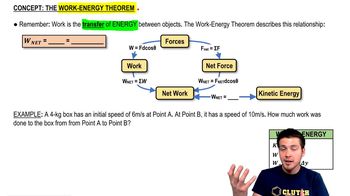
The work-energy principle states that the work done on an object is equal to the change in its kinetic energy. In this context, calculating the work done to move protons involves understanding how energy is transferred and transformed, particularly from potential to kinetic energy as the protons move.
Video consigliato:
Percorso guidato
04:10
The Work-Energy Theorem

Conservation of Energy

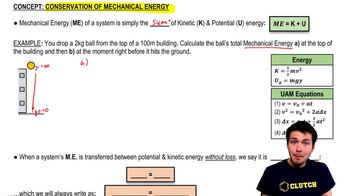
Conservation of energy is a fundamental principle stating that energy cannot be created or destroyed, only transformed. When protons are released, their potential energy due to electrostatic forces is converted into kinetic energy, allowing us to calculate their speed at different separations using energy conservation.
Video consigliato:
Percorso guidato
06:24
Conservation Of Mechanical Energy