Ch 23: Electric Potential
Young & Freedman Calc - University Physics 14th Edition
Young & Freedman Calc14th EditionUniversity PhysicsISBN: 9780321973610Non è quello che usi tu?Cambia libro di testo
Capitolo 23, Problema 9b

Two protons are released from rest when they are 0.7500.750 nm apart. What is the maximum acceleration they will achieve and when does this acceleration occur?

Guida verificata passo dopo passo
1
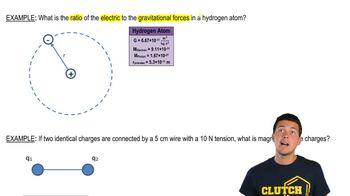
First, understand that the protons will repel each other due to the electrostatic force between them. This force can be calculated using Coulomb's Law, which is given by: F=k⁢q1⁢q2r2, where k is Coulomb's constant, q1 and q2 are the charges of the protons, and r is the distance between them.
Next, calculate the force between the protons using the values: k = 8.99 x 10⁹ N m2/C2, q1 = q2 = 1.60 x 10⁻¹⁹ C, and r = 0.750 nm = 0.750 x 10⁻⁹ m.
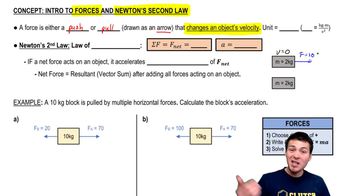
Once the force is calculated, use Newton's second law to find the acceleration of each proton. Newton's second law states: F=m⁢a, where m is the mass of a proton (approximately 1.67 x 10⁻²⁷ kg) and a is the acceleration.
Solve for the acceleration a using the formula: a=Fm. Substitute the values of F and m to find the maximum acceleration.
The maximum acceleration occurs at the initial moment when the protons are released from rest, as the force is greatest when they are closest together. As they move apart, the force and thus the acceleration will decrease.

Risposta video verificata per un problema simile:

Questa soluzione video è stata consigliata dai nostri tutor come utile per risolvere questo problema.
Durata del video:
4m

Concetti chiave

Ecco i concetti essenziali che devi comprendere per rispondere correttamente alla domanda.

Coulomb's Law

Coulomb's Law describes the electrostatic force between two charged particles. It states that the force is directly proportional to the product of the charges and inversely proportional to the square of the distance between them. This law is crucial for calculating the initial force acting on the protons due to their electric charge.
Video consigliato:

Newton's Second Law of Motion

Newton's Second Law states that the acceleration of an object is directly proportional to the net force acting on it and inversely proportional to its mass. This principle is essential for determining the acceleration of the protons once the electrostatic force is known, as it relates force, mass, and acceleration.
Video consigliato:
Percorso guidato
06:54
Intro to Forces & Newton's Second Law

Conservation of Energy

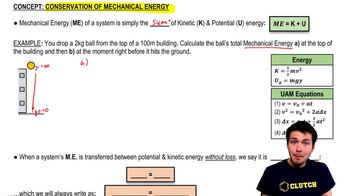
The conservation of energy principle asserts that the total energy in a closed system remains constant. As the protons move apart, their potential energy due to electrostatic forces converts into kinetic energy, influencing their acceleration. Understanding this energy transformation helps determine when maximum acceleration occurs.
Video consigliato:
Percorso guidato
06:24
Conservation Of Mechanical Energy
Pratica correlata
Domanda del libro di testo

Two protons, starting several meters apart, are aimed directly at each other with speeds of 2.00×1052.00\(\times\)10^5 m/s, measured relative to the earth. Find the maximum electric force that these protons will exert on each other.

2471
views
1
rank
Domanda del libro di testo

A particle with charge +4.20+4.20 nC is in a uniform electric field EE directed to the left. The charge is released from rest and moves to the left; after it has moved 6.006.00 cm, its kinetic energy is +2.20x10⁻⁶+2.20x10^{-6} J. What is the work done by the electric force?

2817
views
Domanda del libro di testo

Two stationary point charges +3.00+3.00 nC and +2.00+2.00 nC are separated by a distance of 50.050.0 cm. An electron is released from rest at a point midway between the two charges and moves along the line connecting the two charges. What is the speed of the electron when it is 10.010.0 cm from the +3.00+3.00-nC charge?

5349
views
1
comments
Domanda del libro di testo

A small particle has charge −5.00-5.00 μμC and mass 2.00×10−42.00\(\times\)10^{-4} kg. It moves from point AA, where the electric potential is VA=+200V_A = +200 V, to point BB, where the electric potential is VB=+800V_B = +800 V. The electric force is the only force acting on the particle. The particle has speed 5.005.00 m/s at point AA. What is its speed at point BB? Is it moving faster or slower at BB than at AA? Explain.

3734
views
Domanda del libro di testo

How much work would it take to push two protons very slowly from a separation of 2.00×10−102.00\(\times\)10^{-10} m (a typical atomic distance) to 3.00×10−153.00\(\times\)10^{-15} m (a typical nuclear distance)? If the protons are both released from rest at the closer distance in part (a), how fast are they moving when they reach their original separation?

4214
views
Domanda del libro di testo

A small metal sphere, carrying a net charge of q1=−2.80q_1 = -2.80 μC, is held in a stationary position by insulat­ing supports. A second small metal sphere, with a net charge of q2=−7.80q_2 = -7.80 μC and mass 1.501.50 g, is projected toward q1q_1. When the two spheres are 0.8000.800 m apart, q2q_2, is moving toward q1q_1 with speed 22.022.0 m/s (Fig. E23.523.5). Assume that the two spheres can be treated as point charges. You can ignore the force of gravity. What is the speed of q2q_2 when the spheres are 0.4000.400 m apart?

3277
views
1
rank