

The vapor pressure is the pressure of the vapor phase of a substance when it is in equilibrium with the solid or liquid phase of the substance. The relative humidity is the partial pressure of water vapor in the air divided by the vapor pressure of water at that same temperature, expressed as a percentage. The air is saturated when the humidity is . The vapor pressure of water at °C is Pa. If the air temperature is °C and the relative humidity is , what is the partial pressure of water vapor in the atmosphere (that is, the pressure due to water vapor alone)?
Ch 18: Thermal Properties of Matter
Young & Freedman Calc14th EditionUniversity PhysicsISBN: 9780321973610Non è quello che usi tu?Cambia libro di testo
Tutti i libri di testo
Young & Freedman Calc 14th Edition
Ch 18: Thermal Properties of Matter
Problema 42a
Young & Freedman Calc 14th Edition
Ch 18: Thermal Properties of Matter
Problema 42aCapitolo 18, Problema 42a
For a gas of nitrogen molecules (N2), what must the temperature be if of all the molecules have speeds less than m/s? Use Table . The molar mass of N2 is g/mol.
Guida verificata passo dopo passo1
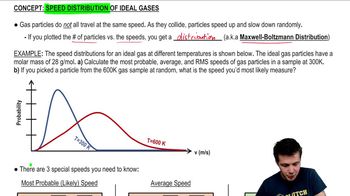
First, understand that the problem involves the Maxwell-Boltzmann distribution of molecular speeds in a gas. This distribution describes the probability of molecules having certain speeds at a given temperature.
Next, convert the molar mass of nitrogen (N2) from grams per mole to kilograms per mole. Since 1 gram = 0.001 kilograms, the molar mass of N2 is 28.0 g/mol, which is equivalent to 0.028 kg/mol.
Use the Maxwell-Boltzmann speed distribution formula to relate the fraction of molecules with speeds less than a given value to the temperature. The formula involves the most probable speed, which is given by: , where is the Boltzmann constant, is the temperature, and is the mass of a molecule.
Determine the fraction of molecules with speeds less than 1500 m/s using the cumulative distribution function (CDF) of the Maxwell-Boltzmann distribution. This involves integrating the probability density function up to the speed of 1500 m/s.
Finally, solve for the temperature that corresponds to 94.7% of molecules having speeds less than 1500 m/s. This requires using the inverse of the CDF and the known values to find .

Risposta video verificata per un problema simile:
Questa soluzione video è stata consigliata dai nostri tutor come utile per risolvere questo problema.
Durata del video:
4mConcetti chiave
Ecco i concetti essenziali che devi comprendere per rispondere correttamente alla domanda.
Maxwell-Boltzmann Distribution
The Maxwell-Boltzmann distribution describes the distribution of speeds among molecules in a gas. It is crucial for understanding how molecular speeds vary with temperature. The distribution is characterized by a peak at the most probable speed, and the shape of the curve changes with temperature, affecting the fraction of molecules below a certain speed.
Video consigliato:
Percorso guidato
Speed Distribution & Special Speeds of Ideal Gases
Root Mean Square Speed
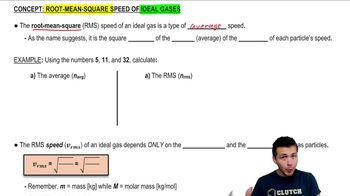
The root mean square (RMS) speed is a measure of the average speed of particles in a gas, derived from the Maxwell-Boltzmann distribution. It is calculated using the formula v_rms = sqrt(3kT/m), where k is the Boltzmann constant, T is the temperature, and m is the mass of a molecule. This concept helps relate temperature to molecular speed.
Video consigliato:
Percorso guidato
Root-Mean-Square Speed of Ideal Gases
Molar Mass and Molecular Speed
Molar mass is the mass of one mole of a substance, and it plays a critical role in determining the speed of gas molecules. For nitrogen (N2), the molar mass is 28.0 g/mol, which must be converted to kg for calculations. The molecular speed is inversely related to the molar mass, affecting how temperature influences the speed distribution of the molecules.
Video consigliato:
Percorso guidato
Introduction to Kinetic-Molecular Theory
Pratica correlata
Domanda del libro di testo
3222
views
1
rank
Domanda del libro di testo
Solid water (ice) is slowly warmed from a very low temperature. What minimum external pressure must be applied to the solid if a melting phase transition is to be observed? Describe the sequence of phase transitions that occur if the applied pressure is such that .
1012
views
Domanda del libro di testo
For diatomic carbon dioxide gas (CO2, molar mass g/mol) at K, calculate the most probable speed .
1963
views
1
rank
Domanda del libro di testo
For diatomic carbon dioxide gas (CO2, molar mass g/mol) at K, calculate the average speed .
1631
views
Domanda del libro di testo
For diatomic carbon dioxide gas (CO2, molar mass g/mol) at K, calculate the root-mean-square speed .
2080
views