How much heat does it take to increase the temperature of mol of an ideal gas by K near room temperature if the gas is held at constant volume and is diatomic?
Ch 18: Thermal Properties of Matter
Young & Freedman Calc14th EditionUniversity PhysicsISBN: 9780321973610Non è quello che usi tu?Cambia libro di testo
Tutti i libri di testo
Young & Freedman Calc 14th Edition
Ch 18: Thermal Properties of Matter
Problema 41a
Young & Freedman Calc 14th Edition
Ch 18: Thermal Properties of Matter
Problema 41aCapitolo 18, Problema 41a
For diatomic carbon dioxide gas (CO2, molar mass g/mol) at K, calculate the most probable speed .
Guida verificata passo dopo passo1
First, understand that the most probable speed \( v_{mp} \) for a gas molecule is given by the formula \( v_{mp} = \sqrt{\frac{2kT}{m}} \), where \( k \) is the Boltzmann constant \( (1.38 \times 10^{-23} \text{ J/K}) \), \( T \) is the temperature in Kelvin, and \( m \) is the mass of a single molecule.
Convert the molar mass of CO2 from grams per mole to kilograms per molecule. Since the molar mass is 44.0 g/mol, convert this to kg/mol by dividing by 1000, resulting in 0.044 kg/mol. Then, divide by Avogadro's number \( (6.022 \times 10^{23} \text{ molecules/mol}) \) to find the mass of a single molecule.
Substitute the values into the formula for \( v_{mp} \). Use \( T = 300 \text{ K} \) and the calculated mass of a single CO2 molecule.
Calculate the expression \( \frac{2kT}{m} \) using the values for \( k \), \( T \), and \( m \).
Finally, take the square root of the result from the previous step to find the most probable speed \( v_{mp} \).

Risposta video verificata per un problema simile:
Questa soluzione video è stata consigliata dai nostri tutor come utile per risolvere questo problema.
Durata del video:
3mConcetti chiave
Ecco i concetti essenziali che devi comprendere per rispondere correttamente alla domanda.
Maxwell-Boltzmann Distribution
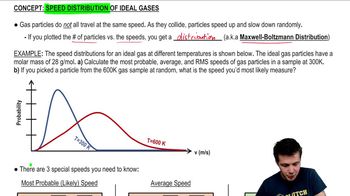
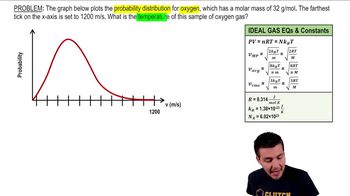
The Maxwell-Boltzmann distribution describes the distribution of speeds among particles in a gas. It is crucial for understanding how the most probable speed, average speed, and root-mean-square speed are derived. The distribution is dependent on temperature and particle mass, influencing the speed of gas molecules.
Video consigliato:
Percorso guidato
Speed Distribution & Special Speeds of Ideal Gases
Most Probable Speed
The most probable speed (v_mp) is the speed at which the largest number of gas molecules are moving, according to the Maxwell-Boltzmann distribution. It is calculated using the formula v_mp = sqrt(2kT/m), where k is the Boltzmann constant, T is the temperature, and m is the mass of a molecule.
Video consigliato:
Percorso guidato
Probability Distribution Graph
Molar Mass and Molecular Mass
Molar mass is the mass of one mole of a substance, expressed in grams per mole, and is essential for converting between moles and grams. For gases, the molecular mass is used to calculate the mass of individual molecules, which is necessary for determining speeds using the Maxwell-Boltzmann distribution.
Video consigliato:
Percorso guidato
Mass Spectrometers
Pratica correlata
Domanda del libro di testo
2051
views
Domanda del libro di testo
How much heat does it take to increase the temperature of mol of an ideal gas by K near room temperature if the gas is held at constant volume and is monatomic?
1663
views
Domanda del libro di testo
For diatomic carbon dioxide gas (CO2, molar mass g/mol) at K, calculate the average speed .
1631
views
Domanda del libro di testo
Compute the specific heat at constant volume of nitrogen (N2) gas, and compare it with the specific heat of liquid water. The molar mass of N2 is g/mol.
2605
views
Domanda del libro di testo
For a gas of nitrogen molecules (N2), what must the temperature be if of all the molecules have speeds less than m/s? Use Table . The molar mass of N2 is g/mol.
1870
views
Domanda del libro di testo
For diatomic carbon dioxide gas (CO2, molar mass g/mol) at K, calculate the root-mean-square speed .
2080
views