
Smoke particles in the air typically have masses of the order of kg. The Brownian motion (rapid, irregular movement) of these particles, resulting from collisions with air molecules, can be observed with a microscope. Find the root-mean-square speed of Brownian motion for a particle with a mass of kg in air at K.
Young & Freedman Calc 14th Edition
Ch 18: Thermal Properties of Matter
Problema 37aHow much heat does it take to increase the temperature of mol of an ideal gas by K near room temperature if the gas is held at constant volume and is diatomic?
Guida verificata passo dopo passo
Risposta video verificata per un problema simile:
Concetti chiave
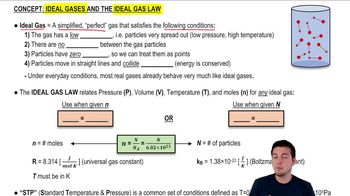
Ideal Gas Law
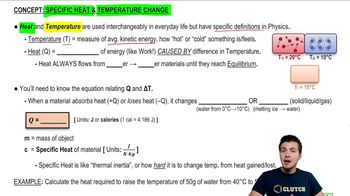
Specific Heat Capacity at Constant Volume (Cv)
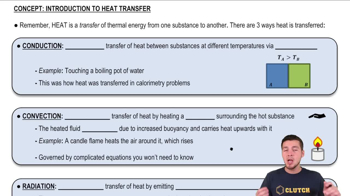
Heat Transfer in Thermodynamics
How much heat does it take to increase the temperature of mol of an ideal gas by K near room temperature if the gas is held at constant volume and is monatomic?
For diatomic carbon dioxide gas (CO2, molar mass g/mol) at K, calculate the most probable speed .
Calculate the mean free path of air molecules at atm and K. (This pressure is readily attainable in the laboratory; see Exercise .) As in Example , model the air molecules as spheres of radius m.
Compute the specific heat at constant volume of nitrogen (N2) gas, and compare it with the specific heat of liquid water. The molar mass of N2 is g/mol.
At what temperature is the root-mean-square speed of nitrogen molecules equal to the root-mean-square speed of hydrogen molecules at °C? (Hint: Appendix D shows the molar mass (in g/mol) of each element under the chemical symbol for that element. The molar mass of H2 is twice the molar mass of hydrogen atoms, and similarly for N2.)