Ch 19: The First Law of Thermodynamics
Young & Freedman Calc - University Physics 14th Edition
Young & Freedman Calc14th EditionUniversity PhysicsISBN: 9780321973610Non è quello che usi tu?Cambia libro di testo
Capitolo 19, Problema 8d

Figure E19.819.8 shows a pVpV-diagram for an ideal gas in which its absolute temperature at bb is one-fourth of its absolute temperature at aa. Did heat enter or leave the gas from aa to bb? How do you know?
pV diagram illustrating pressure and volume at points a and b for an ideal gas.

Guida verificata passo dopo passo
1
Identify the process: The pV-diagram shows a horizontal line from point a to point b, indicating an isobaric process (constant pressure).
Use the ideal gas law: For an ideal gas, the relationship between pressure (P), volume (V), and temperature (T) is given by the equation \( PV = nRT \), where n is the number of moles and R is the ideal gas constant.
Relate temperatures at points a and b: According to the problem, the temperature at b (\( T_b \)) is one-fourth of the temperature at a (\( T_a \)). Therefore, \( T_b = \frac{1}{4} T_a \).
Analyze the change in volume: Since the process is isobaric and the temperature decreases, the volume must also decrease to maintain the relationship \( PV = nRT \). This is consistent with the diagram showing a decrease in volume from a to b.
Determine heat transfer: In an isobaric process, the change in internal energy (\( \Delta U \)) is related to the heat added to the system (Q) and the work done by the system (W) by the first law of thermodynamics: \( \Delta U = Q - W \). Since the temperature decreases, \( \Delta U \) is negative, indicating that heat must have left the system (Q is negative).

Risposta video verificata per un problema simile:

Questa soluzione video è stata consigliata dai nostri tutor come utile per risolvere questo problema.
Durata del video:
2m

Concetti chiave

Ecco i concetti essenziali che devi comprendere per rispondere correttamente alla domanda.

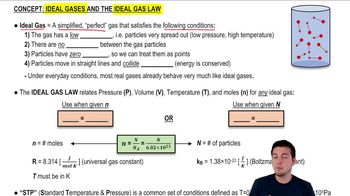
Ideal Gas Law

The Ideal Gas Law relates the pressure (p), volume (V), and temperature (T) of an ideal gas through the equation PV = nRT, where n is the number of moles and R is the ideal gas constant. This law helps predict how a gas will behave under varying conditions of pressure and temperature, making it essential for understanding gas behavior in thermodynamic processes.
Video consigliato:
Percorso guidato
07:21
Ideal Gases and the Ideal Gas Law

Thermodynamic Processes

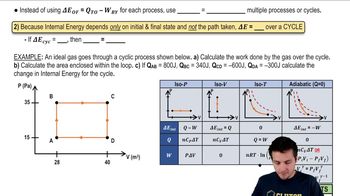
Thermodynamic processes describe how a system changes from one state to another, often involving heat transfer. In this case, the transition from point a to point b on the pV diagram indicates a change in volume while pressure remains constant, which is characteristic of an isobaric process. Understanding these processes is crucial for determining whether heat is absorbed or released.
Video consigliato:
Percorso guidato
08:45
Properties of Cyclic Thermodynamic Processes

Heat Transfer

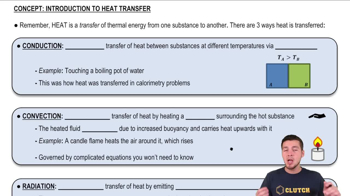
Heat transfer refers to the movement of thermal energy from one object or system to another due to a temperature difference. In the context of the question, analyzing the change in temperature from point a to point b helps determine if heat entered or left the gas. If the temperature decreases, it indicates that heat has left the system, while an increase would suggest heat has entered.
Video consigliato:
Percorso guidato
05:14
Overview of Heat Transfer
Pratica correlata
Domanda del libro di testo

Five moles of an ideal monatomic gas with an initial temperature of 127127°C expand and, in the process, absorb 15001500 J of heat and do 21002100 J of work. What is the final temperature of the gas?

2210
views

Domanda del libro di testo

A gas undergoes two processes. In the first, the volume remains constant at 0.2000.200 m3 and the pressure increases from 2.00×1052.00\(\times\)10^5 Pa to 5.00×1055.00\(\times\)10^5 Pa. The second process is a compression to a volume of 0.1200.120 m3 at a constant pressure of 5.00×1055.00\(\times\)10^5 Pa. Find the total work done by the gas during both processes.

2420
views
2
rank
Domanda del libro di testo

A gas in a cylinder expands from a volume of 0.1100.110 m3 to 0.3200.320 m3 . Heat flows into the gas just rapidly enough to keep the pressure constant at 1.65×1051.65\(\times\)10^5 Pa during the expansion. The total heat added is 1.15×1051.15\(\times\)10^5 J. Find the work done by the gas.

1752
views
Domanda del libro di testo

The process abcabc shown in the pVpV-diagram in Fig. E19.1119.11 involves 0.01750.0175 mol of an ideal gas. What was the lowest temperature the gas reached in this process? Where did it occur?

2602
views
1
rank
Domanda del libro di testo

In Fig. 19.719.7a, consider the closed loop 1→3→2→4→11 → 3 → 2 → 4 → 1. This is a cyclic process in which the initial and final states are the same. Find the total work done by the system in this cyclic process, and show that it is equal to the area enclosed by the loop.

3816
views
Domanda del libro di testo

A gas undergoes two processes. In the first, the volume remains constant at 0.2000.200 m3 and the pressure increases from 2.00×1052.00\(\times\)10^5 Pa to 5.00×1055.00\(\times\)10^5 Pa. The second process is a compression to a volume of 0.1200.120 m3 at a constant pressure of 5.00×1055.00\(\times\)10^5 Pa. In a pVpV-diagram, show both processes.

1457
views