
Ch 25: Current, Resistance, and EMF
Young & Freedman Calc - University Physics 14th Edition
Young & Freedman Calc14th EditionUniversity PhysicsISBN: 9780321973610Non è quello che usi tu?Cambia libro di testo
Capitolo 25, Problema 39d

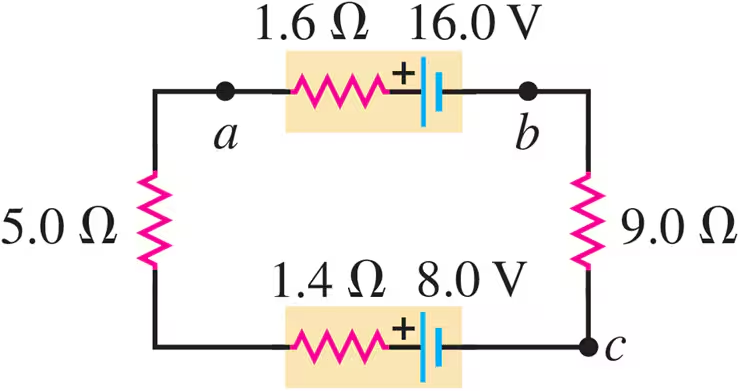
Consider the circuit of Fig. E25.30 Show that the power output of the 16.0 V battery equals the overall rate of consumption of electrical energy in the rest of the circuit.

Guida verificata passo dopo passo
1
Identify the components in the circuit and their respective values, including resistances, currents, and voltages. This will help in understanding how the circuit is configured and how the power is distributed.
Use Ohm's Law, which states \( V = IR \), to calculate the current flowing through each resistor. This requires knowing the total resistance in the circuit and the voltage provided by the battery.
Calculate the power output of the battery using the formula \( P = IV \), where \( I \) is the current through the battery and \( V \) is the voltage of the battery. This gives the total power supplied by the battery.
Determine the power consumed by each resistor using the formula \( P = I^2R \), where \( I \) is the current through the resistor and \( R \) is the resistance. Sum the power consumed by all resistors to find the total power consumption in the circuit.
Verify that the total power output of the battery equals the total power consumed by the resistors. This confirms that the power supplied by the battery is equal to the power consumed in the circuit, demonstrating energy conservation.

Risposta video verificata per un problema simile:

Questa soluzione video è stata consigliata dai nostri tutor come utile per risolvere questo problema.

Concetti chiave

Ecco i concetti essenziali che devi comprendere per rispondere correttamente alla domanda.

Conservation of Energy in Electrical Circuits

The principle of conservation of energy states that energy cannot be created or destroyed, only transformed. In electrical circuits, this means the total power supplied by sources, like batteries, must equal the total power consumed by the circuit components, such as resistors. This balance ensures that all energy input is accounted for in the form of heat, light, or other energy forms.
Video consigliato:
Percorso guidato
06:24
Conservation Of Mechanical Energy

Power in Electrical Circuits

Power in electrical circuits is the rate at which energy is transferred or converted. It is calculated as the product of voltage and current (P = VI). For a battery, the power output is determined by its voltage and the current it supplies. Understanding power is crucial for analyzing how energy is distributed and consumed within a circuit.
Video consigliato:
Percorso guidato
06:18
Power in Circuits

Ohm's Law and Circuit Analysis

Ohm's Law relates voltage (V), current (I), and resistance (R) in a circuit through the equation V = IR. This fundamental relationship helps in analyzing circuits by allowing the calculation of current flow and voltage drops across components. Applying Ohm's Law is essential for determining how the power supplied by a battery is distributed across the circuit elements.
Video consigliato:
Percorso guidato
03:07
Resistance and Ohm's Law