Ch 25: Current, Resistance, and EMF
Young & Freedman Calc - University Physics 14th Edition
Young & Freedman Calc14th EditionUniversity PhysicsISBN: 9780321973610Non è quello che usi tu?Cambia libro di testo
Capitolo 25, Problema 30

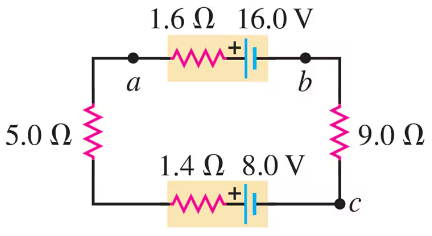
The circuit shown in Fig. E25.3025.30 contains two batteries, each with an emf and an internal resistance, and two resistors. Find the potential difference VacV_{ac} of point aa with respect to point cc.
Circuit diagram with two batteries, internal resistances, and resistors labeled with values. Points a, b, and c marked.

Guida verificata passo dopo passo
1
Identify the components in the circuit: two batteries with emfs of 12.0 V and 5.0 V, internal resistances of 1.85 Ω and 1.25 Ω, and resistors of 8.50 Ω, 4.50 Ω, and 15.0 Ω.
Apply Kirchhoff's loop rule to the circuit. Choose a loop that includes points a and c, and write the equation for the sum of potential differences around the loop. Consider the direction of current flow and the polarity of the batteries.
Calculate the current in the circuit using the loop equation. You may need to solve a system of equations if there are multiple loops. Use Ohm's law, \( V = IR \), where \( V \) is the voltage, \( I \) is the current, and \( R \) is the resistance.
Determine the potential difference across each component between points a and c. For resistors, use \( V = IR \). For batteries, consider the emf and internal resistance.
Sum the potential differences from point a to point c to find \( V_{ac} \). Remember to account for the direction of current and the sign of each potential difference.

Risposta video verificata per un problema simile:

Questa soluzione video è stata consigliata dai nostri tutor come utile per risolvere questo problema.
Durata del video:
9m

Concetti chiave

Ecco i concetti essenziali che devi comprendere per rispondere correttamente alla domanda.

Kirchhoff's Loop Rule

Kirchhoff's Loop Rule states that the sum of the potential differences around any closed loop in a circuit must equal zero. This principle is based on the conservation of energy, ensuring that the energy supplied by the batteries is equal to the energy used by the resistors and any other components. Applying this rule helps determine unknown voltages or currents in complex circuits.
Video consigliato:
Percorso guidato
11:15
Intro to Kirchhoff's Loop Rule

Electromotive Force (EMF) and Internal Resistance

Electromotive force (EMF) is the voltage generated by a battery or power source when no current flows. However, real batteries have internal resistance, which causes a voltage drop when current flows. The effective voltage across the battery terminals is the EMF minus the voltage drop due to internal resistance, affecting the total potential difference in the circuit.
Video consigliato:

Potential Difference

Potential difference, or voltage, between two points in a circuit is the work done to move a unit charge from one point to another. It is measured in volts and is crucial for understanding how energy is transferred in a circuit. Calculating the potential difference between points a and c involves considering the contributions from resistors and batteries along the path.
Video consigliato:
Percorso guidato
07:04
Potential Difference Between Two Charges