
Ch 31: Alternating Current
Young & Freedman Calc - University Physics 14th Edition
Young & Freedman Calc14th EditionUniversity PhysicsISBN: 9780321973610Non è quello che usi tu?Cambia libro di testo
Capitolo 31, Problema 15b

You have a 200-Ω resistor, a 0.400-H inductor, and a 6.00-μF capacitor. They are connected to form an L-R-C series circuit. What is the current amplitude?

Guida verificata passo dopo passo
1
First, identify the components of the L-R-C series circuit: a resistor (R = 200 Ω), an inductor (L = 0.400 H), and a capacitor (C = 6.00 μF).
Calculate the angular frequency (ω) of the circuit using the formula for resonance frequency: ω = 1 / √(L * C). Convert the capacitance from microfarads to farads before calculation.
Determine the impedance (Z) of the circuit using the formula: Z = √(R² + (ωL - 1/ωC)²). This accounts for the resistive, inductive, and capacitive components.
Use Ohm's Law to find the current amplitude (I₀) in the circuit. The formula is: I₀ = V₀ / Z, where V₀ is the voltage amplitude across the circuit.
Ensure that all units are consistent when performing calculations, especially converting microfarads to farads and ensuring angular frequency is in radians per second.

Risposta video verificata per un problema simile:

Questa soluzione video è stata consigliata dai nostri tutor come utile per risolvere questo problema.
Durata del video:
3m

Concetti chiave

Ecco i concetti essenziali che devi comprendere per rispondere correttamente alla domanda.

Impedance in an L-R-C Circuit

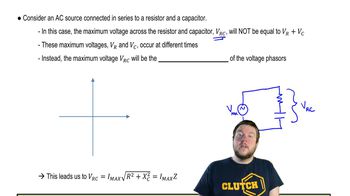
In an L-R-C series circuit, impedance (Z) is the total opposition to the flow of alternating current, combining resistance (R), inductive reactance (X_L), and capacitive reactance (X_C). It is calculated using the formula Z = √(R² + (X_L - X_C)²), where X_L = ωL and X_C = 1/(ωC), with ω being the angular frequency. Understanding impedance is crucial for determining the current amplitude in the circuit.
Video consigliato:
Percorso guidato
08:40
Impedance in AC Circuits

Resonance in L-R-C Circuits

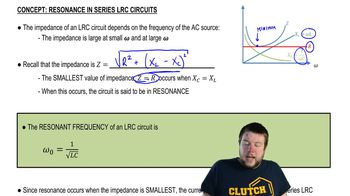
Resonance occurs in an L-R-C circuit when the inductive reactance equals the capacitive reactance (X_L = X_C), resulting in the impedance being purely resistive (Z = R). At resonance, the circuit allows maximum current flow, and the current amplitude is at its peak. This concept is essential for analyzing the behavior of the circuit at different frequencies.
Video consigliato:
Percorso guidato
05:23
Resonance in Series LRC Circuits

Current Amplitude in AC Circuits

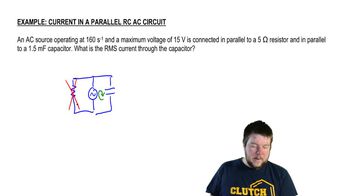
The current amplitude in an AC circuit is the maximum value of the current that flows through the circuit. It is determined by the voltage amplitude (V_m) and the impedance (Z) using the formula I_m = V_m/Z. Understanding how to calculate the current amplitude is vital for analyzing the performance of the L-R-C circuit under alternating current conditions.
Video consigliato:
Percorso guidato
03:45
Current in a Parallel RC AC Circuit