Ch 26: Direct-Current Circuits
Young & Freedman Calc - University Physics 14th Edition
Young & Freedman Calc14th EditionUniversity PhysicsISBN: 9780321973610Non è quello che usi tu?Cambia libro di testo
Capitolo 26, Problema 5b

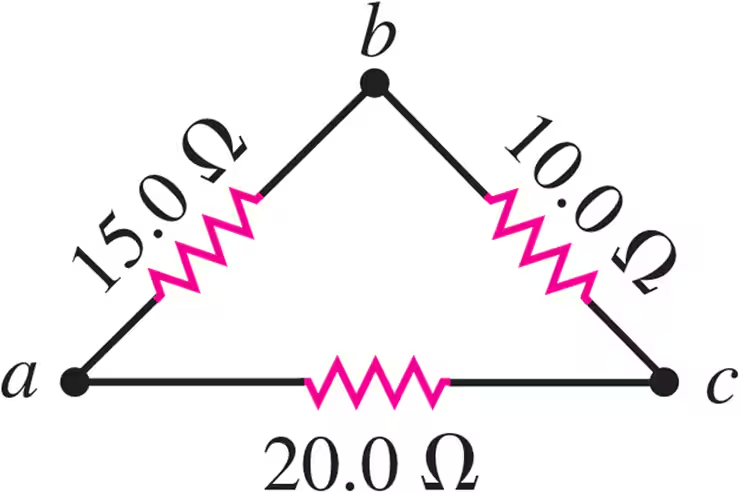
A triangular array of resistors is shown in Fig. E26.5. What current will this array draw from a 35.0 V battery having negligible internal resistance if we connect it across bc?

Guida verificata passo dopo passo
1
Identify the resistors in the triangular array: 18.0 Ω, 22.0 Ω, and 13.0 Ω.
Since the battery is connected across points b and c, determine which resistors are in series or parallel between these points.
Calculate the equivalent resistance of the resistors between points b and c. If resistors are in series, add their resistances. If in parallel, use the formula: 1/R_eq = 1/R1 + 1/R2 + ...
Once the equivalent resistance (R_eq) is found, use Ohm's Law to find the current drawn from the battery: I = V/R_eq, where V is the voltage of the battery (35.0 V).
Substitute the known values into the equation to solve for the current I, ensuring all units are consistent.

Risposta video verificata per un problema simile:

Questa soluzione video è stata consigliata dai nostri tutor come utile per risolvere questo problema.
Durata del video:
6m

Concetti chiave

Ecco i concetti essenziali che devi comprendere per rispondere correttamente alla domanda.

Ohm's Law

Ohm's Law is a fundamental principle in electronics and electrical engineering, stating that the current (I) through a conductor between two points is directly proportional to the voltage (V) across the two points and inversely proportional to the resistance (R) of the conductor. It is mathematically expressed as I = V/R. This law is essential for calculating the current in a circuit when the voltage and resistance are known.
Video consigliato:
Percorso guidato
03:07
Resistance and Ohm's Law

Series and Parallel Circuits

In a series circuit, resistors are arranged in a single path, so the same current flows through each resistor. The total resistance is the sum of individual resistances. In a parallel circuit, resistors are connected across the same two points, providing multiple paths for the current. The total resistance in a parallel circuit is found using the reciprocal formula: 1/R_total = 1/R1 + 1/R2 + ... + 1/Rn. Understanding these configurations is crucial for analyzing complex circuits.
Video consigliato:
Percorso guidato
09:51
Combining Capacitors in Series & Parallel

Kirchhoff's Voltage Law

Kirchhoff's Voltage Law (KVL) states that the sum of the electrical potential differences (voltage) around any closed network is zero. This principle is used to analyze the voltage drops across components in a circuit loop, ensuring that the total voltage supplied by sources equals the total voltage drop across the resistors. KVL is vital for solving circuits with multiple loops and branches, as it helps in setting up equations to find unknown values.
Video consigliato:
Percorso guidato
04:08
Kirchhoff's Junction Rule
Pratica correlata
Domanda del libro di testo

A triangular array of resistors is shown in Fig. E26.5. What current will this array draw from a 35.0 V battery having negligible internal resistance if we connect it across ac?

1468
views

Domanda del libro di testo

A uniform wire of resistance R is cut into three equal lengths. One of these is formed into a circle and connected between the other two (Fig. E26.1). What is the resistance between the opposite ends a and b?

2079
views
2
rank
Domanda del libro di testo

A triangular array of resistors is shown in Fig. E26.5. If the battery has an internal resistance of 3.00Ω, what current will the array draw if the battery is connected across bc?

1865
views
Domanda del libro di testo

A machine part has a resistor X protruding from an opening in the side. This resistor is connected to three other resistors, as shown in Fig. E26.2. An ohmmeter connected across a and b reads 2.00 Ω. What is the resistance of X?

2801
views
Domanda del libro di testo

Power Rating of a Resistor. The power rating of a resistor is the maximum power the resistor can safely dissipate without too great a rise in temperature and hence damage to the resistor. If the power rating of a 15 kΩ resistor is 5.0 W, what is the maximum allowable potential difference across the terminals of the resistor?

1703
views
Domanda del libro di testo

A triangular array of resistors is shown in Fig. E26.5. What current will this array draw from a 35.0 V battery having negligible internal resistance if we connect it across ab?

1627
views