

Ch 26: Direct-Current Circuits
Young & Freedman Calc - University Physics 14th Edition
Young & Freedman Calc14th EditionUniversity PhysicsISBN: 9780321973610Non è quello che usi tu?Cambia libro di testo
Capitolo 26, Problema 33a

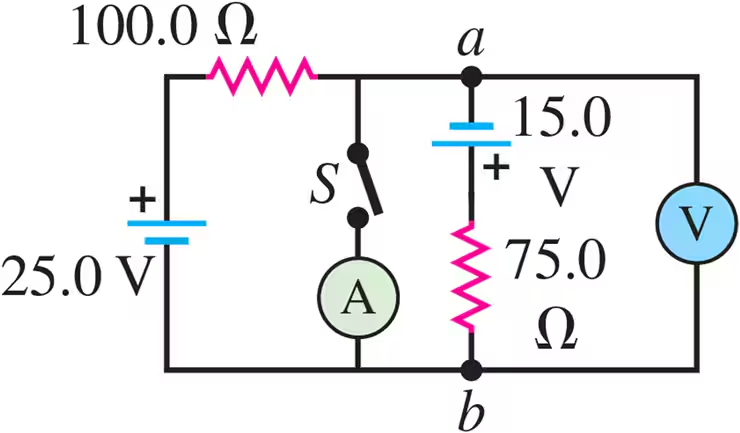
In the circuit shown in Fig. E26.33 all meters are idealized and the batteries have no appreciable internal resistance. Find the reading of the voltmeter with the switch S open. Which point is at a higher potential: a or b?

Guida verificata passo dopo passo
1
Identify the components in the circuit: There are two batteries (10.00 V and 30.00 V), three resistors (25.00 Ω, 50.00 Ω, and 5.00 Ω), and a voltmeter V1. The switch S is open, so the 5.00 Ω resistor is not part of the circuit.
Determine the potential difference across the voltmeter V1: With the switch S open, the circuit forms a loop with the 10.00 V battery, the 25.00 Ω resistor, and the 50.00 Ω resistor. The 30.00 V battery is in parallel with the voltmeter.
Apply Kirchhoff's loop rule to the loop: Start from the negative terminal of the 10.00 V battery, move through the 25.00 Ω resistor, and then through the 50.00 Ω resistor, returning to the positive terminal of the 10.00 V battery. The sum of the potential differences around the loop should be zero.
Calculate the current in the loop: Use Ohm's Law (V = IR) to find the current I in the loop. The total resistance in the loop is the sum of the 25.00 Ω and 50.00 Ω resistors.
Determine the reading of the voltmeter V1: The voltmeter measures the potential difference between points M and N. Since the 30.00 V battery is in parallel with the voltmeter, the reading of V1 is the potential difference across the 30.00 V battery, which is 30.00 V. Point M is at a higher potential than point N.

Risposta video verificata per un problema simile:

Questa soluzione video è stata consigliata dai nostri tutor come utile per risolvere questo problema.
Durata del video:
1m

Concetti chiave

Ecco i concetti essenziali che devi comprendere per rispondere correttamente alla domanda.

Kirchhoff's Loop Rule

Kirchhoff's Loop Rule states that the sum of the potential differences (voltage) around any closed loop in a circuit must equal zero. This principle is essential for analyzing circuits, as it allows us to calculate unknown voltages or currents by considering the voltage contributions from batteries and resistors within the loop.
Video consigliato:
Percorso guidato
11:15
Intro to Kirchhoff's Loop Rule

Potential Difference

Potential difference, or voltage, is the measure of the work needed to move a charge between two points in an electric field. In circuits, it is the difference in electric potential between two points, which drives current flow. Understanding potential difference is crucial for determining which point in a circuit is at a higher potential.
Video consigliato:
Percorso guidato
07:04
Potential Difference Between Two Charges

Ohm's Law

Ohm's Law relates the voltage across a resistor to the current flowing through it and its resistance, expressed as V = IR. This fundamental principle helps in calculating the voltage drop across resistors, which is necessary for applying Kirchhoff's Loop Rule and understanding the behavior of the circuit when the switch is open.
Video consigliato:
Percorso guidato
03:07
Resistance and Ohm's Law
Pratica correlata
Domanda del libro di testo

The 10.00 V battery in Fig. E26.28 is removed from the circuit and reinserted with the opposite polarity, so that its positive terminal is now next to point a. The rest of the circuit is as shown in the figure. Find the current in each branch.

1386
views
Domanda del libro di testo

In the circuit shown in Fig. E26.34, the 6.0 Ω resistor is consuming energy at a rate of 24 J/s when the current through it flows as shown. What are the polarity and emf ε of the unknown battery, assuming it has negligible internal resistance?

2733
views
2
rank
1
comments
Domanda del libro di testo

The 5.00 V battery in Fig. E26.28 is removed from the circuit and replaced by a 15.00 V battery, with its negative terminal next to point b. The rest of the circuit is as shown in the figure. Find the current in each branch.

3120
views
1
comments
Domanda del libro di testo

The heating element of an electric dryer is rated at 4.1 kW when connected to a 240 V line. What is the resistance of the dryer's heating element at its operating temperature?

1575
views
Domanda del libro di testo

An emf source with ε = 120V, a resistor with R = 80.0Ω, and a capacitor with C = 4.00 μF are connected in series. As the capacitor charges, when the current in the resistor is 0.900 A, what is the magnitude of the charge on each plate of the capacitor?

1506
views
Domanda del libro di testo

In the circuit shown in Fig. E26.31 the batteries have negligible internal resistance and the meters are both idealized. With the switch S open, the voltmeter reads 15.0 V. What will the ammeter read when the switch is closed?

2274
views