Ch 32: Electromagnetic Waves

Young & Freedman Calc14th EditionUniversity PhysicsISBN: 9780321973610
Non è quello che usi tu?Cambia libro di testoScegli un libro di testo diverso
TOC.tableOfContents
- Ch 01: Units, Physical Quantities & Vectors41
- Ch 02: Motion Along a Straight Line67
- Ch 03: Motion in Two or Three Dimensions47
- Ch 04: Newton's Laws of Motion23
- Ch 05: Applying Newton's Laws59
- Ch 06: Work & Kinetic Energy14
- Ch 07: Potential Energy & Conservation8
- Ch 08: Momentum, Impulse, and Collisions18
- Ch 09: Rotation of Rigid Bodies42
- Ch 10: Dynamics of Rotational Motion48
- Ch 11: Equilibrium & Elasticity27
- Ch 12: Fluid Mechanics31
- Ch 13: Gravitation35
- Ch 14: Periodic Motion32
- Ch 15: Mechanical Waves25
- Ch 16: Sound & Hearing32
- Ch 17: Temperature and Heat36
- Ch 18: Thermal Properties of Matter38
- Ch 19: The First Law of Thermodynamics33
- Ch 20: The Second Law of Thermodynamics22
- Ch 21: Electric Charge and Electric Field36
- Ch 22: Gauss' Law24
- Ch 23: Electric Potential31
- Ch 24: Capacitance and Dielectrics18
- Ch 25: Current, Resistance, and EMF26
- Ch 26: Direct-Current Circuits30
- Ch 27: Magnetic Field and Magnetic Forces18
- Ch 28: Sources of Magnetic Field10
- Ch 29: Electromagnetic Induction28
- Ch 30: Inductance17
- Ch 31: Alternating Current21
- Ch 32: Electromagnetic Waves1
- Ch 33: The Nature and Propagation of Light20
- Ch 34: Geometric Optics34
- Ch 35: Interference19
- Ch 36: Diffraction25
- Ch 37: Special Relativity20
- Ch 38: Photons: Light Waves Behaving as Particles15
- Ch 39: Particles Behaving as Waves26
- Ch 40: Quantum Mechanics I: Wave Functions21
- Ch 41: Quantum Mechanics II: Atomic Structure25
- Ch 42: Molecules and Condensed Matter18
- Ch 43: Nuclear Physics16
- Ch 44: Particle Physics and Cosmology23
Young & Freedman Calc14th EditionUniversity PhysicsISBN: 9780321973610Non è quello che usi tu?Cambia libro di testo

Capitolo 32, Problema 37
The magnetic field within a long, straight solenoid with a circular cross section and radius R is increasing at a rate of dB/dt. (a) What is the rate of change of flux through a circle with radius r1 inside the solenoid, normal to the axis of the solenoid, and with center on the solenoid axis? (b) Find the magnitude of the induced electric field inside the solenoid, at a distance r1 from its axis. Show the direction of this field in a diagram. (c) What is the magnitude of the induced electric field outside the solenoid, at a distance r2 from the axis?
 Guida verificata passo dopo passo
1
Step 1: Understand the problem setup. We have a solenoid with a magnetic field increasing at a rate of dB/dt. We need to find the rate of change of magnetic flux through a circle of radius r_1 inside the solenoid, and the induced electric fields both inside and outside the solenoid.
Step 2: For part (a), calculate the rate of change of magnetic flux through the circle of radius r_1. The magnetic flux Φ through a surface is given by Φ = B * A, where B is the magnetic field and A is the area of the surface. Here, A = π * r_1^2. The rate of change of flux is dΦ/dt = d(B * A)/dt = A * dB/dt, since A is constant.
Step 3: For part (b), use Faraday's law of electromagnetic induction, which states that the induced electromotive force (emf) around a closed loop is equal to the negative rate of change of magnetic flux through the loop. The induced electric field E inside the solenoid at a distance r_1 is related to the emf by the equation emf = E * 2π * r_1. Set emf = -dΦ/dt and solve for E.
Step 4: For part (b), determine the direction of the induced electric field. According to Lenz's law, the direction of the induced electric field will be such that it opposes the change in magnetic flux. If the magnetic field is increasing, the induced electric field will circulate in a direction that creates a magnetic field opposing the increase.
Step 5: For part (c), consider the region outside the solenoid. The magnetic field outside an ideal solenoid is zero, but the changing magnetic field inside the solenoid can still induce an electric field outside. Use the same approach as in part (b) to find the magnitude of the induced electric field at a distance r_2 from the axis, considering the entire flux change within the solenoid.
Risposta video verificata per un problema simile:
Questa soluzione video è stata consigliata dai nostri tutor come utile per risolvere questo problema.

Durata del video:
11mConcetti chiave
Ecco i concetti essenziali che devi comprendere per rispondere correttamente alla domanda.
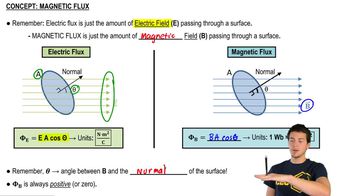
Magnetic Flux
Magnetic flux refers to the measure of the magnetic field passing through a given area. It is calculated as the product of the magnetic field strength (B) and the area (A) perpendicular to the field, expressed as Φ = B * A. In the context of a solenoid, the flux through a circle inside it depends on the magnetic field within the solenoid and the area of the circle.
Video consigliato:
Percorso guidato
 04:52
04:52
Magnetic Flux
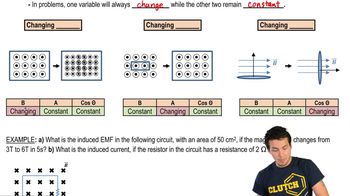
Faraday's Law of Electromagnetic Induction
Faraday's Law states that a change in magnetic flux through a circuit induces an electromotive force (EMF) in the circuit. The induced EMF is proportional to the rate of change of the magnetic flux, given by EMF = -dΦ/dt. This principle is crucial for determining the induced electric field inside and outside the solenoid as the magnetic field changes.
Video consigliato:
Percorso guidato
 09:26
09:26Faraday's Law
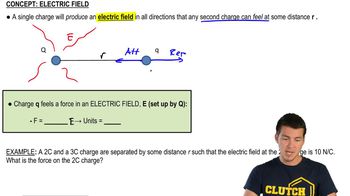
Induced Electric Field
An induced electric field arises in response to a changing magnetic field, as described by Faraday's Law. Inside a solenoid, this field forms concentric circles around the axis, with its magnitude depending on the rate of change of the magnetic field and the distance from the axis. Outside the solenoid, the field's behavior changes, requiring a different approach to determine its magnitude and direction.
Video consigliato:
Percorso guidato
 03:16
03:16Intro to Electric Fields
0