
Ch 35: Interference
Young & Freedman Calc - University Physics 14th Edition
Young & Freedman Calc14th EditionUniversity PhysicsISBN: 9780321973610Non è quello che usi tu?Cambia libro di testo
Capitolo 35, Problema 35

Two rectangular pieces of plane glass are laid one upon the other on a table. A thin strip of paper is placed between them at one edge so that a very thin wedge of air is formed. The plates are illuminated at normal incidence by 546-nm light from a mercury-vapor lamp. Interference fringes are formed, with 15.0 fringes per centimeter. Find the angle of the wedge.

Guida verificata passo dopo passo
1
Step 1: Understand the problem. The interference fringes are formed due to the thin wedge of air between the glass plates. The number of fringes per unit length is related to the wavelength of the light and the angle of the wedge. We need to calculate the angle of the wedge using the given data.
Step 2: Recall the formula for fringe spacing in a wedge-shaped air film. The distance between adjacent fringes (Δx) is given by: Δx=λθ, where λ is the wavelength of the light and θ is the angle of the wedge.
Step 3: Use the relationship between fringe density and fringe spacing. Fringe density (number of fringes per unit length) is the reciprocal of fringe spacing: n=1Δx. Here, n = 15 fringes per centimeter, and Δx = 1/n.
Step 4: Substitute the value of Δx into the formula for fringe spacing. Rearrange the formula to solve for θ: θ=λΔx. Use λ = 546 nm (convert to meters: 546 × 10⁻⁹ m) and Δx = 1/n (convert n to fringes per meter: 15 × 100 fringes per meter).
Step 5: Perform the substitution and simplify the expression for θ. This will give the angle of the wedge in radians. If needed, convert the angle to degrees using the conversion factor: θ(degrees)=θ(radians)×180π.

Risposta video verificata per un problema simile:

Questa soluzione video è stata consigliata dai nostri tutor come utile per risolvere questo problema.

Concetti chiave

Ecco i concetti essenziali che devi comprendere per rispondere correttamente alla domanda.

Interference of Light

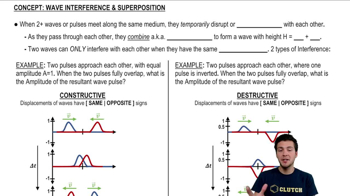
Interference occurs when two or more light waves overlap, resulting in a new wave pattern. This phenomenon can produce bright and dark fringes, known as interference fringes, due to constructive and destructive interference. In this scenario, the thin wedge of air between the glass plates causes varying path lengths for the light waves, leading to the observed fringes.
Video consigliato:
Percorso guidato
03:47
Wave Interference & Superposition

Wedge Formation

A wedge is a geometrical shape that tapers from one end to another, creating a varying thickness. In the context of this problem, the thin air wedge formed between the two glass plates leads to a gradient in the optical path length of the light. The angle of the wedge can be determined by analyzing the spacing of the interference fringes, which is directly related to the wedge's geometry.
Video consigliato:
Percorso guidato
06:55
Blocks on a Wedge

Fringe Spacing and Wavelength

The spacing of the interference fringes is influenced by the wavelength of the light used and the angle of the wedge. The number of fringes per unit length can be related to the wavelength and the wedge angle through the formula for fringe spacing. In this case, knowing the wavelength of the light (546 nm) and the fringe density (15 fringes/cm) allows for the calculation of the wedge angle using principles of geometry and wave optics.
Video consigliato:
Percorso guidato
09:05
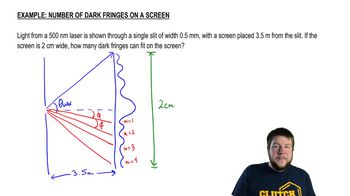
Number of Dark Fringes on a Screen