

Two rectangular pieces of plane glass are laid one upon the other on a table. A thin strip of paper is placed between them at one edge so that a very thin wedge of air is formed. The plates are illuminated at normal incidence by 546-nm light from a mercury-vapor lamp. Interference fringes are formed, with 15.0 fringes per centimeter. Find the angle of the wedge.
Ch 35: Interference
Young & Freedman Calc14th EditionUniversity PhysicsISBN: 9780321973610Non è quello che usi tu?Cambia libro di testo
Capitolo 35, Problema 35
What is the thinnest soap film (excluding the case of zero thickness) that appears black when illuminated with light with wavelength 480 nm? The index of refraction of the film is 1.33, and there is air on both sides of the film.
Guida verificata passo dopo passo1
Identify the condition for destructive interference in the soap film, which occurs when the path difference between the light waves reflected from the top and bottom surfaces of the film leads to a phase difference of an odd multiple of \(\pi\). The general condition for destructive interference in thin films is given by \(2nt = m\lambda/n\), where \(n\) is the index of refraction of the film, \(t\) is the thickness of the film, \(\lambda\) is the wavelength of light in vacuum, and \(m\) is an odd integer (1, 3, 5, ...).
Since we are looking for the thinnest film that appears black, we use the smallest odd integer for \(m\), which is 1. This simplifies the condition to \(2nt = \lambda/n\).
Substitute the given values into the equation. The index of refraction \(n = 1.33\) and the wavelength of light \(\lambda = 480\) nm.
Solve the equation \(2nt = \lambda/n\) for \(t\) to find the minimum thickness of the film. Rearrange the equation to \(t = \lambda/(2n^2)\).
Calculate the value of \(t\) using the values of \(\lambda\) and \(n\) to find the thinnest film thickness that results in a black appearance due to destructive interference.

Risposta video verificata per un problema simile:
Questa soluzione video è stata consigliata dai nostri tutor come utile per risolvere questo problema.
Concetti chiave
Ecco i concetti essenziali che devi comprendere per rispondere correttamente alla domanda.
Interference of Light
Interference occurs when two or more light waves overlap, resulting in a new wave pattern. In the context of thin films, constructive and destructive interference can happen depending on the film's thickness and the wavelength of light. For a soap film, specific thicknesses will cause certain wavelengths to be amplified or canceled out, leading to the observed colors.
Video consigliato:
Percorso guidato
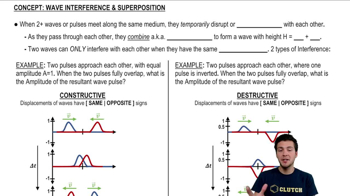
Wave Interference & Superposition
Thin Film Equation
The thin film equation relates the thickness of a film to the wavelength of light and the refractive indices of the film and surrounding media. For a soap film with air on both sides, the condition for destructive interference (which can lead to a black appearance) is given by 2nt = (m + 0.5)λ, where n is the refractive index, t is the thickness, λ is the wavelength, and m is an integer.
Video consigliato:
Percorso guidato
Thin Lens Equation
Refractive Index
The refractive index is a measure of how much light slows down when passing through a medium compared to its speed in a vacuum. For the soap film, with a refractive index of 1.33, this value affects how light interacts with the film, influencing the conditions for interference. The refractive index is crucial for determining the effective wavelength of light within the film, which is necessary for applying the thin film equation.
Video consigliato:
Percorso guidato
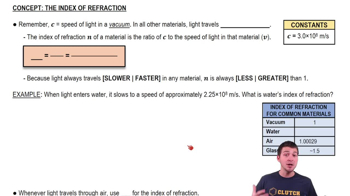
Index of Refraction
Pratica correlata
Domanda del libro di testo
351
views
Domanda del libro di testo
A uniform film of TiO2, 1036 nm thick and having index of refraction 2.62, is spread uniformly over the surface of crown glass of refractive index 1.52. Light of wavelength 520.0 nm falls at normal incidence onto the film from air. You want to increase the thickness of this film so that the reflected light cancels. What is the minimum thickness of TiO2 that you must add so the reflected light cancels as desired?
321
views
Domanda del libro di testo
How far must the mirror M2 (see Fig. 35.19) of the Michelson interferometer be moved so that 1800 fringes of He-Ne laser light (λ = 633 nm) move across a line in the field of view?
<Image>
339
views
