Ch 42: Molecules and Condensed Matter
Young & Freedman Calc - University Physics 14th Edition
Young & Freedman Calc14th EditionUniversity PhysicsISBN: 9780321973610Non è quello che usi tu?Cambia libro di testo
Capitolo 42, Problema 10

The average kinetic energy of an ideal-gas atom or molecule is (32)kT\(\left\)(\(\frac\)32\(\right\))kT, where TT is the Kelvin temperature (Chapter 1818). The rotational inertia of the H2 molecule is 4.6×10−484.6\(\times\)10^{-48} kg-m2. What is the value of TT for which (32)kT\(\left\)(\(\frac\)32\(\right\))kT equals the energy separation between the l=0l = 0 and l=1l = 1 energy levels of H2? What does this tell you about the number of H2 molecules in the l=1l = 1 level at room temperature?

Guida verificata passo dopo passo
1
Step 1: Start by understanding the energy separation between the l = 0 and l = 1 rotational energy levels of the H2 molecule. The energy of a rotational level is given by the formula E_l = (l(l+1)ħ²) / (2I), where l is the rotational quantum number, ħ is the reduced Planck's constant, and I is the rotational inertia of the molecule.
Step 2: Calculate the energy separation ΔE between the l = 0 and l = 1 levels. For l = 0, E_0 = 0 (since l(l+1) = 0). For l = 1, E_1 = (1(1+1)ħ²) / (2I) = (2ħ²) / (2I). Therefore, ΔE = E_1 - E_0 = ħ² / I.
Step 3: Set the average kinetic energy of the molecule, (3/2)kT, equal to the energy separation ΔE. This gives the equation (3/2)kT = ħ² / I, where k is the Boltzmann constant. Solve for T: T = (2ħ²) / (3kI).
Step 4: Substitute the known values into the equation for T. Use ħ = 1.0545718 × 10^-34 J·s, k = 1.380649 × 10^-23 J/K, and I = 4.6 × 10^-48 kg·m². This will allow you to calculate the temperature T.
Step 5: To address the second part of the problem, consider the Boltzmann distribution, which describes the population of molecules in different energy levels. At room temperature (approximately 300 K), compare the thermal energy kT to the energy separation ΔE. If kT is much smaller than ΔE, very few molecules will occupy the l = 1 level. If kT is comparable to or larger than ΔE, a significant number of molecules will be in the l = 1 level.

Risposta video verificata per un problema simile:

Questa soluzione video è stata consigliata dai nostri tutor come utile per risolvere questo problema.
Durata del video:
6m

Concetti chiave

Ecco i concetti essenziali che devi comprendere per rispondere correttamente alla domanda.

Kinetic Energy of Ideal Gas

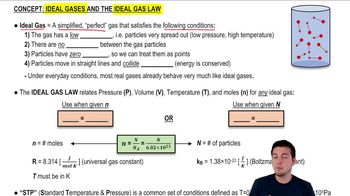
The average kinetic energy of an ideal gas is given by the formula (3/2)kT, where k is the Boltzmann constant and T is the absolute temperature in Kelvin. This relationship indicates that the kinetic energy of gas particles increases linearly with temperature, reflecting the energy associated with their motion. Understanding this concept is crucial for analyzing the thermal behavior of gases and their energy distributions.
Video consigliato:
Percorso guidato
07:21
Ideal Gases and the Ideal Gas Law

Rotational Inertia

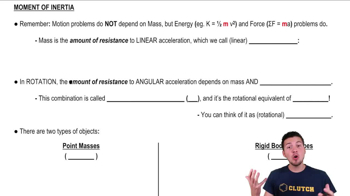
Rotational inertia, or moment of inertia, quantifies an object's resistance to changes in its rotational motion. For molecules like H2, it is determined by the mass distribution relative to the axis of rotation. The rotational inertia affects the energy levels of the molecule, as it influences the spacing between rotational energy states, which is essential for understanding molecular behavior in different energy levels.
Video consigliato:
Percorso guidato
11:47
Intro to Moment of Inertia

Energy Levels in Quantum Mechanics

In quantum mechanics, energy levels represent the discrete states that a system, such as a molecule, can occupy. For the H2 molecule, the quantum number l indicates different rotational states, with energy separations between these levels determined by the rotational inertia. The relationship between temperature and energy levels helps predict the population of molecules in various states at thermal equilibrium, which is vital for understanding molecular distributions at different temperatures.
Video consigliato:
Percorso guidato
06:24
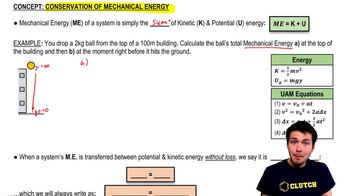
Conservation Of Mechanical Energy
Pratica correlata
Domanda del libro di testo

Calculate the density of states g(E)g(E) for the free-electron model of a metal if E=7.0E = 7.0 eV and V=1.0V = 1.0 cm3. Express your answer in units of states per electron volt.

2208
views

Domanda del libro di testo

The rotational energy levels of CO are calculated in Example 42.242.2. If the energy of the rotating molecule is described by the classical expression K=(12)Iω2K=(\(\frac\)12)I\(\omega\)^2, for the l=1 l = 1 level, what is the rotational period (the time for one rotation)?

206
views
Domanda del libro di testo

The rotational energy levels of CO are calculated in Example 42.242.2. If the energy of the rotating molecule is described by the classical expression K=(12)Iω2K=(\(\frac\)12)I\(\omega\)^2, for the l=1 l = 1 level, what is the angular speed of the rotating molecule?

1385
views
Domanda del libro di testo

The rotational energy levels of CO are calculated in Example 42.242.2. If the energy of the rotating molecule is described by the classical expression K=(12)Iω2K=(\(\frac\)12)I\(\omega\)^2, for the l=1 l = 1 level, what is the linear speed of each atom?

1451
views
Domanda del libro di testo

The maximum wavelength of light that a certain silicon photocell can detect is 1.111.11 mm. What is the energy gap (in electron volts) between the valence and conduction bands for this photocell?

1503
views
Domanda del libro di testo

Potassium bromide (KBr) has a density of 2.75×1032.75\(\times\)10^3 kg/m3 and the same crystal structure as NaCl. The mass of a potassium atom is 6.49×10−266.49\(\times\)10^{-26} kg, and the mass of a bromine atom is 1.33×10−251.33\(\times\)10^{-25} kg. Calculate the average spacing between adjacent atoms in a KBr crystal.

312
views