
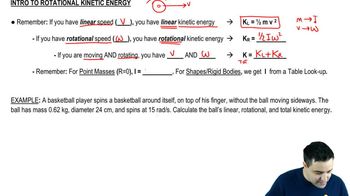
The rotational energy levels of CO are calculated in Example . If the energy of the rotating molecule is described by the classical expression , for the level, what is the rotational period (the time for one rotation)?
Young & Freedman Calc 14th Edition
Ch 42: Molecules and Condensed Matter
Problema 9bThe rotational energy levels of CO are calculated in Example . If the energy of the rotating molecule is described by the classical expression , for the level, what is the linear speed of each atom?
Guida verificata passo dopo passo
Risposta video verificata per un problema simile:
Concetti chiave
Rotational Kinetic Energy
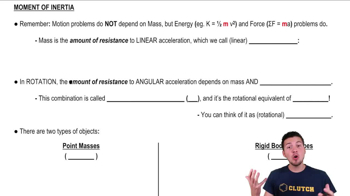
Moment of Inertia
Linear Speed
The rotational energy levels of CO are calculated in Example . If the energy of the rotating molecule is described by the classical expression , for the level, what is the angular speed of the rotating molecule?
The average kinetic energy of an ideal-gas atom or molecule is , where is the Kelvin temperature (Chapter ). The rotational inertia of the H2 molecule is kg-m2. What is the value of for which equals the energy separation between the and energy levels of H2? What does this tell you about the number of H2 molecules in the level at room temperature?
The H2 molecule has a moment of inertia of kg-m2. What is the wavelength of the photon absorbed when H2 makes a transition from the to the rotational level?
Two atoms of cesium (Cs) can form a molecule. The equilibrium distance between the nuclei in a molecule is nm. Calculate the moment of inertia about an axis through the center of mass of the two nuclei and perpendicular to the line joining them. The mass of a cesium atom is kg.
Potassium bromide (KBr) has a density of kg/m3 and the same crystal structure as NaCl. The mass of a potassium atom is kg, and the mass of a bromine atom is kg. Calculate the average spacing between adjacent atoms in a KBr crystal.