Ch 42: Molecules and Condensed Matter
Young & Freedman Calc - University Physics 14th Edition
Young & Freedman Calc14th EditionUniversity PhysicsISBN: 9780321973610Non è quello che usi tu?Cambia libro di testo
Capitolo 42, Problema 6

The H2 molecule has a moment of inertia of 4.6×10−484.6\(\times\)10^{-48} kg-m2. What is the wavelength ll of the photon absorbed when H2 makes a transition from the l=3l = 3 to the l=4l = 4 rotational level?

Guida verificata passo dopo passo
1
Step 1: Understand the rotational energy levels of a diatomic molecule. The energy of a rotational level is given by the formula: El = ll+1 h2π I, where l is the rotational quantum number, h is Planck's constant, and I is the moment of inertia.
Step 2: Calculate the energy difference between the rotational levels l = 3 and l = 4. Use the formula for the energy difference: ΔE = E4 - E3. Substitute the values of l into the energy formula for each level.
Step 3: Express the energy difference in terms of frequency using the relationship E = hν, where ν is the frequency of the photon absorbed. Rearrange the formula to solve for ν: ν = ΔEh.
Step 4: Relate the frequency of the photon to its wavelength using the speed of light equation: c = λν, where c is the speed of light, λ is the wavelength, and ν is the frequency. Rearrange the formula to solve for λ: λ = cν.
Step 5: Substitute the known values for the moment of inertia I = 4.6 × 10-48 kg·m2, Planck's constant h = 6.626 × 10⁻³⁴ J·s, and the speed of light c = 3 × 10⁸ m/s into the equations to calculate the wavelength λ.

Risposta video verificata per un problema simile:

Questa soluzione video è stata consigliata dai nostri tutor come utile per risolvere questo problema.
Durata del video:
6m

Concetti chiave

Ecco i concetti essenziali che devi comprendere per rispondere correttamente alla domanda.

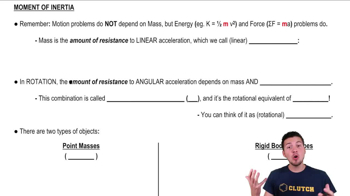
Moment of Inertia

Moment of inertia is a measure of an object's resistance to changes in its rotational motion. For a molecule like H2, it quantifies how mass is distributed relative to the axis of rotation. The moment of inertia affects the energy levels of rotational states, which are crucial for understanding transitions between these states.
Video consigliato:
Percorso guidato
11:47
Intro to Moment of Inertia

Rotational Energy Levels

In quantum mechanics, molecules can occupy discrete rotational energy levels, denoted by quantum numbers (l). The energy associated with these levels is given by the formula E_l = (h^2 * l(l + 1)) / (2 * I), where h is Planck's constant and I is the moment of inertia. Transitions between these levels involve the absorption or emission of photons.
Video consigliato:
Percorso guidato
13:08
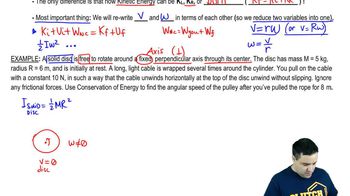
Conservation of Energy with Rotation

Photon Wavelength

The wavelength of a photon is related to its energy by the equation E = h * c / λ, where E is the energy of the photon, h is Planck's constant, c is the speed of light, and λ is the wavelength. When a molecule transitions between rotational levels, the energy difference corresponds to the wavelength of the absorbed or emitted photon, allowing us to calculate λ based on the energy change.
Video consigliato:
Percorso guidato
05:42
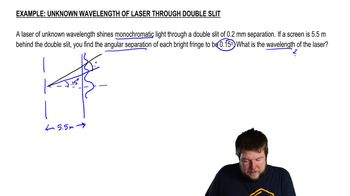
Unknown Wavelength of Laser through Double Slit
Pratica correlata
Domanda del libro di testo

The rotational energy levels of CO are calculated in Example 42.242.2. If the energy of the rotating molecule is described by the classical expression K=(12)Iω2K=(\(\frac\)12)I\(\omega\)^2, for the l=1 l = 1 level, what is the angular speed of the rotating molecule?

1385
views

Domanda del libro di testo

The rotational energy levels of CO are calculated in Example 42.242.2. If the energy of the rotating molecule is described by the classical expression K=(12)Iω2K=(\(\frac\)12)I\(\omega\)^2, for the l=1 l = 1 level, what is the linear speed of each atom?

1451
views
Domanda del libro di testo

During each of these processes, a photon of light is given up. In each process, what wavelength of light is given up, and in what part of the electromagnetic spectrum is that wavelength? A molecule decreases its vibrational energy by 0.1980.198 eV.

1389
views
Domanda del libro di testo

Two atoms of cesium (Cs) can form a Cs2Cs_2 molecule. The equilibrium distance between the nuclei in a Cs2Cs_2 molecule is 0.447 0.447 nm. Calculate the moment of inertia about an axis through the center of mass of the two nuclei and perpendicular to the line joining them. The mass of a cesium atom is 2.21×10−252.21\(\times\)10^{-25} kg.

1171
views
Domanda del libro di testo

For the H2 molecule the equilibrium spacing of the two protons is 0.0740.074 nm. The mass of a hydrogen atom is 1.67×10−271.67\(\times\)10^{-27} kg. Calculate the wavelength of the photon emitted in the rotational transition l=2 l = 2 to l=1l = 1.

1766
views