Ch 44: Particle Physics and Cosmology
Young & Freedman Calc - University Physics 14th Edition
Young & Freedman Calc14th EditionUniversity PhysicsISBN: 9780321973610Non è quello che usi tu?Cambia libro di testo
Capitolo 44, Problema 8a

An electron with a total energy of 30.030.0 GeV collides with a stationary positron. What is the available energy?

Guida verificata passo dopo passo
1
Step 1: Understand the concept of available energy in particle collisions. The available energy is the total energy that can be converted into mass or other forms of energy in the center-of-mass frame of the system. For collisions involving a stationary particle, the available energy depends on the total energy of the moving particle and the rest energy of both particles.
Step 2: Recall the rest energy formula for a particle, which is given by \( E_{rest} = m c^2 \), where \( m \) is the mass of the particle and \( c \) is the speed of light. For an electron and positron, their rest energy is identical because they have the same mass.
Step 3: Use the formula for available energy in the center-of-mass frame for a collision between a moving particle and a stationary particle: \( E_{available} = \sqrt{2 E_{moving} E_{rest} + (E_{rest})^2} \). Here, \( E_{moving} \) is the total energy of the moving electron, and \( E_{rest} \) is the rest energy of the positron.
Step 4: Substitute the given values into the formula. The total energy of the moving electron is \( E_{moving} = 30.0 \, \text{GeV} \), and the rest energy of the positron is \( E_{rest} = 0.511 \, \text{MeV} \), which needs to be converted to GeV (\( 1 \text{GeV} = 1000 \text{MeV} \)).
Step 5: Perform the calculation step-by-step to find \( E_{available} \). First, convert \( E_{rest} \) to GeV, then compute \( 2 E_{moving} E_{rest} \), add \( (E_{rest})^2 \), and finally take the square root to determine the available energy.

Risposta video verificata per un problema simile:

Questa soluzione video è stata consigliata dai nostri tutor come utile per risolvere questo problema.
Durata del video:
1m

Concetti chiave

Ecco i concetti essenziali che devi comprendere per rispondere correttamente alla domanda.

Total Energy in Particle Physics

Total energy in particle physics includes both the rest mass energy and the kinetic energy of a particle. For an electron, this is calculated using Einstein's equation E=mc², where m is the rest mass. In high-energy collisions, the kinetic energy becomes significant, and the total energy is the sum of the rest mass energy and the kinetic energy.
Video consigliato:
Percorso guidato
04:54
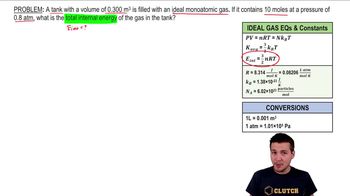
Total Internal Energy

Center of Mass Energy

The available energy in a collision is often referred to as the center of mass energy, which is the energy available for particle interactions. It is calculated by considering the energies of both colliding particles in their center of mass frame. For a stationary positron, the available energy is the total energy of the moving electron plus the rest mass energy of the positron.
Video consigliato:
Percorso guidato
06:30
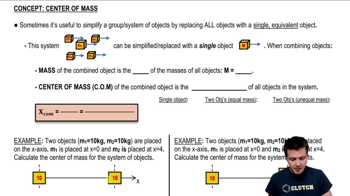
Intro to Center of Mass

Rest Mass Energy

Rest mass energy is the energy equivalent of a particle's mass when it is at rest, given by E=mc². For an electron and positron, their rest mass energies contribute to the total energy available in a collision. In this scenario, the rest mass energy of the positron must be added to the total energy of the electron to determine the total available energy for the interaction.
Video consigliato:
Percorso guidato
8:39
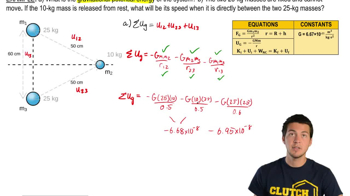
Energy Conservation in Three-Mass System
Pratica correlata
Domanda del libro di testo

Deuterons in a cyclotron travel in a circle with radius 32.032.0 cm just before emerging from the dees. The frequency of the applied alternating voltage is 9.009.00 MHz. Find the magnetic field.

1471
views

Domanda del libro di testo

The starship Enterprise, of television and movie fame, is powered by combining matter and antimatter. If the entire 400400-kg antimatter fuel supply of the Enterprise combines with matter, how much energy is released? How does this compare to the U.S. yearly energy use, which is roughly 1.0×10201.0\(\times\)10^{20} J?

2053
views
Domanda del libro di testo

A proton and an antiproton annihilate, producing two photons. Find the energy, frequency, and wavelength of each photon if the pp and p‾\(\overline{p}\) collide head-on, each with an initial kinetic energy of 620620 MeV.

1344
views
Domanda del libro di testo

A proton and an antiproton annihilate, producing two photons. Find the energy, frequency, and wavelength of each photon if the pp and p‾\(\overline{p}\) are initially at rest.

1983
views
Domanda del libro di testo

A high-energy beam of alpha particles collides with a stationary helium gas target. What must the total energy of a beam particle be if the available energy in the collision is 16.016.0 GeV?

1474
views
Domanda del libro di testo

The magnetic field in a cyclotron that accelerates protons is 1.701.70 T. How many times per second should the potential across the dees reverse? (This is twice the frequency of the circulating protons.)

1318
views