Ch 44: Particle Physics and Cosmology
Young & Freedman Calc - University Physics 14th Edition
Young & Freedman Calc14th EditionUniversity PhysicsISBN: 9780321973610Non è quello che usi tu?Cambia libro di testo
Capitolo 44, Problema 10a

The magnetic field in a cyclotron that accelerates protons is 1.701.70 T. How many times per second should the potential across the dees reverse? (This is twice the frequency of the circulating protons.)

Guida verificata passo dopo passo
1
Determine the relationship between the cyclotron frequency and the magnetic field. The cyclotron frequency (also called the angular frequency) is given by the formula: f=q2πmB, where q is the charge of the proton, m is the mass of the proton, and B is the magnetic field strength.
Substitute the known values into the formula. The charge of a proton is q=1.60×10⁻19 C, the mass of a proton is m=1.67×10⁻27 kg, and the magnetic field strength is B=1.70 T.
Calculate the cyclotron frequency using the formula: f=q2πmB. This will give the frequency of the circulating protons in hertz (Hz).
Since the potential across the dees reverses twice per cycle of the proton's motion, multiply the cyclotron frequency by 2 to find the required frequency of the potential reversal.
Express the final result in hertz (Hz) after performing the calculations, ensuring the units are consistent throughout the process.

Risposta video verificata per un problema simile:

Questa soluzione video è stata consigliata dai nostri tutor come utile per risolvere questo problema.
Durata del video:
2m

Concetti chiave

Ecco i concetti essenziali che devi comprendere per rispondere correttamente alla domanda.

Cyclotron Frequency

Cyclotron frequency refers to the frequency at which a charged particle orbits in a magnetic field. It is determined by the charge of the particle, the mass of the particle, and the strength of the magnetic field. For protons in a magnetic field, the frequency can be calculated using the formula f = (qB)/(2πm), where q is the charge, B is the magnetic field strength, and m is the mass of the proton.
Video consigliato:
Percorso guidato
05:08
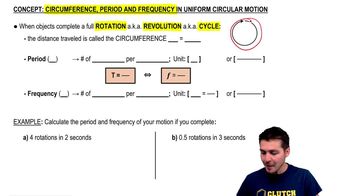
Circumference, Period, and Frequency in UCM

Dees in a Cyclotron

In a cyclotron, the 'dees' are the two D-shaped electrodes that create an oscillating electric field to accelerate charged particles. As protons move between the dees, they gain energy from the electric field, which reverses direction at a specific frequency. The frequency of the electric field must match the cyclotron frequency of the protons to ensure efficient acceleration.

Magnetic Field Strength

Magnetic field strength, measured in teslas (T), is a measure of the intensity of the magnetic field. In a cyclotron, a stronger magnetic field allows for higher energy acceleration of particles. The magnetic field influences the radius of the particle's path and its frequency of rotation, which is crucial for determining how often the electric potential across the dees must reverse to maintain synchronization with the protons.
Video consigliato:
Percorso guidato
05:30
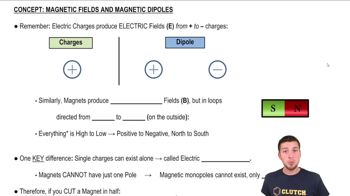
Magnetic Fields and Magnetic Dipoles