Ch 01: Units, Physical Quantities & Vectors
Young & Freedman Calc - University Physics 15th Edition
Young & Freedman Calc15th EditionUniversity PhysicsISBN: 9780135159552Non è quello che usi tu?Cambia libro di testo
Capitolo 1, Problema 25

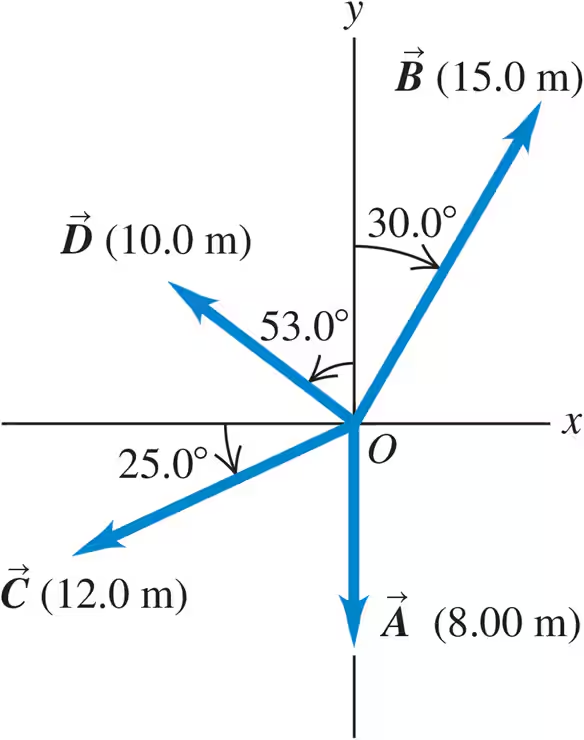
Compute the x- and y-components of the vectors A, B, C, and D in Fig. E1.24.

Guida verificata passo dopo passo
1
Identify the vectors and their respective angles with the positive x-axis: Vector N (14 cm, 13°), Vector M (21 cm, 62°), Vector P (17 cm, 40°), and Vector O (25 cm, 45°).
For each vector, use the trigonometric functions to find the x-component: x-component = magnitude * cos(angle).
For each vector, use the trigonometric functions to find the y-component: y-component = magnitude * sin(angle).
Apply the formulas to Vector N: x-component = 14 * cos(13°), y-component = 14 * sin(13°).
Apply the formulas to Vector M: x-component = 21 * cos(62°), y-component = 21 * sin(62°).

Risposta video verificata per un problema simile:

Questa soluzione video è stata consigliata dai nostri tutor come utile per risolvere questo problema.
Durata del video:
5m

Concetti chiave

Ecco i concetti essenziali che devi comprendere per rispondere correttamente alla domanda.

Vector Components

Vectors can be broken down into their x- and y-components, which represent the vector's influence in the horizontal and vertical directions, respectively. This is done using trigonometric functions: the x-component is found using the cosine of the angle, and the y-component is found using the sine of the angle, both multiplied by the vector's magnitude.
Video consigliato:
Percorso guidato
07:30
Vector Addition By Components

Trigonometric Functions

Trigonometric functions, such as sine and cosine, are essential for resolving vectors into components. For a vector at an angle θ from the positive x-axis, the cosine function helps find the adjacent side (x-component), while the sine function helps find the opposite side (y-component) of the right triangle formed by the vector.
Video consigliato:
Percorso guidato
08:30
Intro to Wave Functions

Reference Angles and Quadrants

Understanding the quadrant in which a vector lies is crucial for determining the signs of its components. Angles are typically measured from the positive x-axis, and the sign of the components depends on the vector's direction: positive in the first quadrant, negative in the second for x, and so on. This helps in correctly applying trigonometric functions to find vector components.
Video consigliato:
Percorso guidato
14:10
Inertial Reference Frames
Pratica correlata
Domanda del libro di testo

For the vectors A and B in Fig. E1.24, use a scale drawing to find the magnitude and direction of the vector difference A − B.

2411
views

Domanda del libro di testo

Vector A has y-component Ay = +9.60 m. A makes an angle of 32.0° counterclockwise from the +y-axis. (a) What is the x-component of A? (b) What is the magnitude of A?

2434
views
Domanda del libro di testo

Let θ be the angle that the vector A makes with the +x-axis, measured counterclockwise from that axis. Find angle θ for a vector that has these components: Ax = 2.00m, Ay = −1.00 m

2592
views
Domanda del libro di testo

A postal employee drives a delivery truck over the route shown in Fig. E1.25. Use the method of components to determine the magnitude and direction of her resultant displacement. In a vector-addition diagram (roughly to scale), show that the resultant displacement found from your diagram is in qualitative agreement with the result you obtained by using the method of components.

4472
views
1
rank
1
comments
Domanda del libro di testo

A spelunker is surveying a cave. She follows a passage 180 m straight west, then 210 m in a direction 45° east of south, and then 280 m at 30° east of north. After a fourth displacement, she finds herself back where she started. Use a scale drawing to determine the magnitude and direction of the fourth displacement.

5495
views
2
rank
1
comments
Domanda del libro di testo

For the vectors A and B in Fig. E1.24 use the method of components to find the magnitude and direction of the vector sum A + B


3113
views