Ch 01: Units, Physical Quantities & Vectors
Young & Freedman Calc - University Physics 15th Edition
Young & Freedman Calc15th EditionUniversity PhysicsISBN: 9780135159552Non è quello che usi tu?Cambia libro di testo
Capitolo 1, Problema 29a

For the vectors A and B in Fig. E1.24 use the method of components to find the magnitude and direction of the vector sum A + B


Vector diagram E1.24 with vectors A, B, C, and D, showing angles for component addition.

Guida verificata passo dopo passo
1
Identify the components of vector A. Since vector A is along the negative y-axis, its components are: \( A_x = 0 \) and \( A_y = -8.0 \text{ m} \).
Determine the components of vector B. Vector B makes a 30° angle with the positive y-axis. The components are: \( B_x = 15.0 \text{ m} \times \sin(30°) \) and \( B_y = 15.0 \text{ m} \times \cos(30°) \).
Calculate the x and y components of vector B using trigonometric functions: \( B_x = 15.0 \text{ m} \times 0.5 \) and \( B_y = 15.0 \text{ m} \times \sqrt{3}/2 \).
Add the components of vectors A and B to find the components of the resultant vector \( \vec{R} = \vec{A} + \vec{B} \). Thus, \( R_x = A_x + B_x \) and \( R_y = A_y + B_y \).
Calculate the magnitude of the resultant vector \( \vec{R} \) using the Pythagorean theorem: \( R = \sqrt{R_x^2 + R_y^2} \). Determine the direction by finding the angle \( \theta \) with respect to the x-axis using \( \theta = \tan^{-1}(R_y/R_x) \).

Risposta video verificata per un problema simile:

Questa soluzione video è stata consigliata dai nostri tutor come utile per risolvere questo problema.
Durata del video:
4m

Concetti chiave

Ecco i concetti essenziali che devi comprendere per rispondere correttamente alla domanda.

Vector Addition

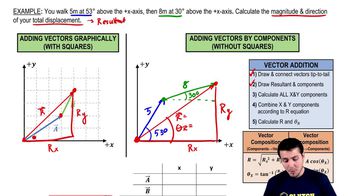
Vector addition involves combining two or more vectors to determine a resultant vector. This can be done graphically or analytically. In the graphical method, vectors are placed head-to-tail, while in the analytical method, the components of each vector are summed separately in the x and y directions to find the resultant's magnitude and direction.
Video consigliato:
Percorso guidato
07:30
Vector Addition By Components

Components of a Vector

A vector can be broken down into its components along the x and y axes. The x-component is found using the cosine of the angle, while the y-component is determined using the sine of the angle. This decomposition simplifies calculations, allowing for the use of basic algebra to find the resultant vector's magnitude and direction.
Video consigliato:
Percorso guidato
07:30
Vector Addition By Components

Magnitude and Direction

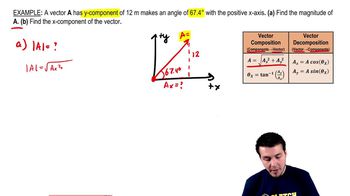
The magnitude of a vector is its length, representing the quantity it describes, while the direction indicates where the vector points. The magnitude can be calculated using the Pythagorean theorem when the components are known, and the direction can be found using the arctangent function to determine the angle relative to a reference axis.
Video consigliato:
Percorso guidato
03:59
Calculating Magnitude & Components of a Vector